Summer Solstice | The Dayman Cometh and Goeth
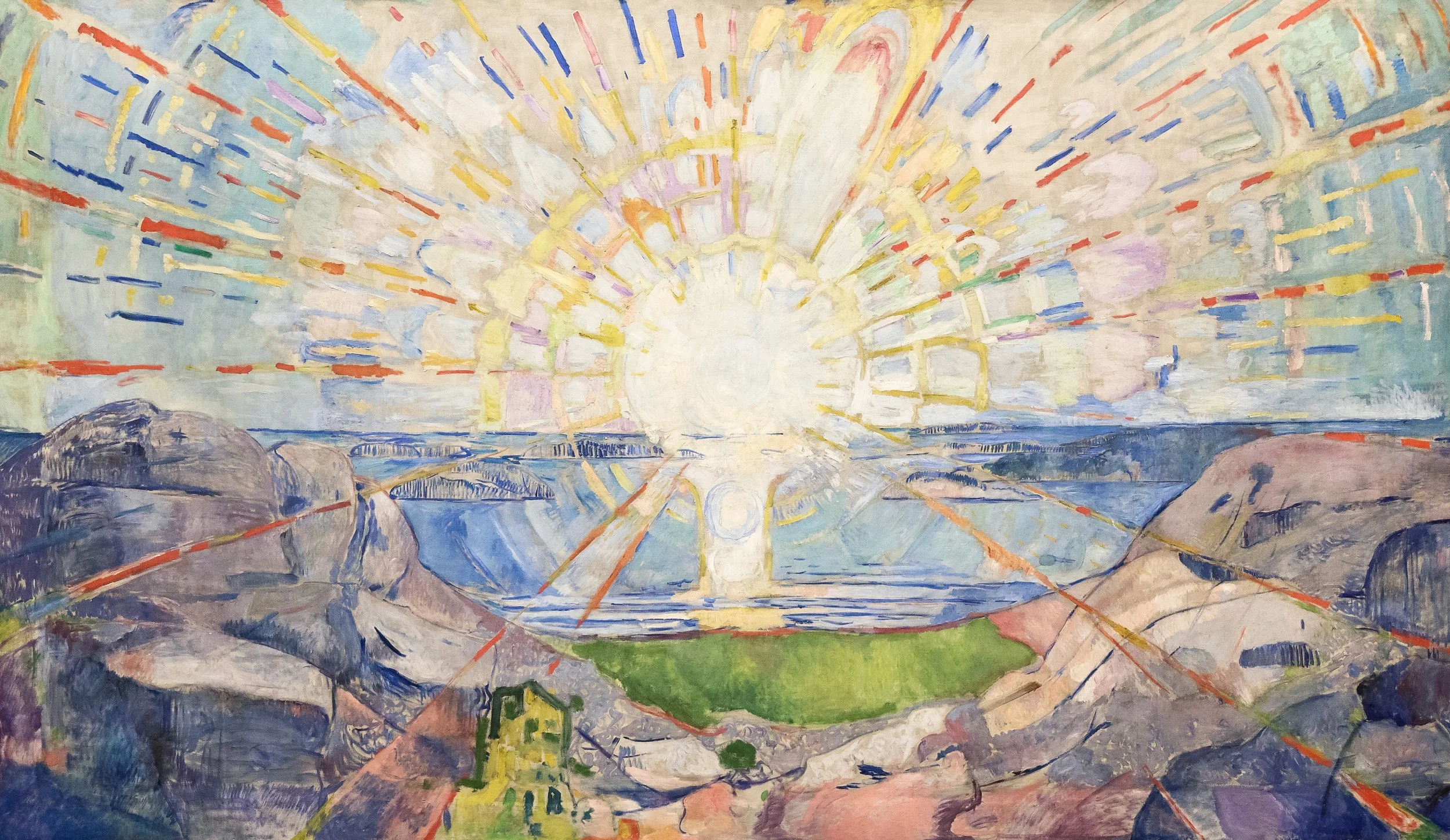
Edvard Munch's Solenintro, 1912
We are fast approaching the Summer Solstice. The year of the Fire Horse is no joke. It feels like time is speeding up, which according to many mystics I know and work with, it is. The Summer Solstice, also referred to as Midsummer, Midsomer or Litha within the modern Pagan Wheel of the Year, marks one of the great turning points of the seasonal cycle.
The Summer Solstice is often viewed as a celebration of light, abundance, vitality, and growth. Yet hidden within the longest day of the year is a paradox. The moment the Sun reaches its greatest strength is also the moment the wheel begins to turn. From this point forward, the days gradually grow shorter. The light has won, but its victory contains the seed of its eventual surrender. One of the most popular modern myths associated with the Summer Solstice in modern Pagan traditions is the tale of the Oak King and the Holly King. While often presented as an ancient Celtic myth, the story is actually much more recent. There are no surviving Celtic texts that describe two kings battling for control of the seasons, and the story appears to have emerged during the twentieth-century Pagan revival, drawing inspiration from older European folklore, seasonal symbolism, and the work of mythographers such as Robert Graves. Nevertheless, the story represents the timeless duality of light and dark, expansion and contraction, yin and yang, and the turning of the wheel through the seasons.
Despite its relatively modern origins, the story resonates because it captures something our ancestors understood well: nature moves in cycles. The Oak King governs the waxing half of the year, from the Winter Solstice to the Summer Solstice, while the Holly King presides over the waning half. And because of the way my brain works, I immediately thought of the Dayman and the Nightman from It’s Always Sunny in Philadelphia. The song fits perfectly with this modern pagan mythology.
Dayman, (ahh-ahhhhhh) fighter of the Nightman (ahh-uhh ahhhh)…Champion of the Sun. What we can’t say for sure is if the Oak King was a master of karate and friendship for everyone, but I would assume so. Somewhere between silliness and seriousness, this is archetypes in action. The Oak King, aka Dayman, reaches his peak strength at the Solstice, when the sun stands at its highest point. Fields are green, crops are growing healthy, the warmth of the sun is inescapable, and everywhere, life is buzzing and abundant. But the very next day, despite several months of warm, summer weather, the days slowly but surely get shorter. The Holly King, aka the Nightman, has won, and the season begins its subtle waning toward Winter. Perhaps this is the moment where the Nightman pays the Troll Toll for the boy’s soul, and before we know it, darkness returns with the cold come Autumn.
Part of what makes the Dayman song so funny is that, beneath all the absurdity, it follows the structure of an ancient hero myth. Charlie wasn’t trying to write modern mythology; he was trying, yet again, to convince the Waitress to fall in love with him. But in the process, he instinctively reached for one of humanity’s oldest narrative patterns: the Champion of Light confronting the forces of darkness. The episode is hilarious and absurd, but the story itself is living, breathing mythology and I’m here for it.
What’s interesting is that we don’t actually experience that shift right away. Summer doesn’t suddenly disappear because the wheel has turned. In fact, the hottest days of the year are usually still weeks away in July and August, which we traditionally think of as peak Summer. The turning point has already happened, even if we haven’t fully felt it yet. In many ways, that’s what the Solstice is really about. The wheel turns before we feel it. In many ways, that’s what the Solstice is really about. The wheel turns before we feel it. This is the peak of the inhale, before the slow, subtle exhale into the darker, winter months.
Astrologically, the Solstice also marks the Sun’s transition from Gemini into Cancer. Just as the wheel begins its slow turn toward Winter, the Sun moves from the sign of information, curiosity, and movement into the sign of home, ancestry, memory, and belonging. It’s a subtle shift from gathering knowledge to finding meaning, from looking outward to reconnecting with what nourishes us.
Of course, unlike Charlie’s over-the-top battle between Dayman and Nightman, the Oak King and Holly King were never really about good defeating evil. While the Oak King and Holly King are often portrayed as rivals battling for control of the seasons, I’ve always preferred to think of them as two sides of the same archetype. One governs growth, expansion, action, and the waxing half of the year. The other governs rest, reflection, wisdom, and the waning half. Rather than enemies, they feel more like partners in an eternal dance, each taking the throne when their season arrives.
It’s similar to the relationship between Brigid and the Cailleach in modern Celtic spirituality. Depending on the tradition, they are sometimes viewed as separate beings and sometimes as different aspects of the same goddess, as the maiden and the crone. Brigid is associated with spring, fertility, inspiration, and new life, while the Cailleach is associated with winter, wisdom, age, and the wild forces of nature. At Imbolc, Brigid begins to emerge as winter loosens its grip on the land. At Samhain, the Cailleach returns as the world turns inward once more. Like the Oak King and Holly King, they are often understood not as opponents, but as seasonal expressions of the same cyclical force.
Regardless of how modern or ancient, these stories continue to resonate. They remind us that light and shadow, growth and rest, summer and winter aren’t opposites in the way we often think of them. One becomes the other. The Oak King doesn’t simply disappear when he loses, any more than the Holly King suddenly arrives with frost and snow. They overlap. They exchange places gradually. The wheel turns, and each contains the seed of the next season within it.
Maybe that’s why this particular Solstice feels so significant. In a few short weeks, Jupiter moves into Leo, completing a series of major planetary sign changes that have unfolded over the last eighteen months and moving us fully into a collective Fire and Air chapter. Whether viewed through mythology, astrology, or the changing of the seasons, there is a sense that the wheel is turning in more ways than one. So enjoy the sunlight while it’s here. After all, tomorrow belongs to the Nightman.