Saraswati
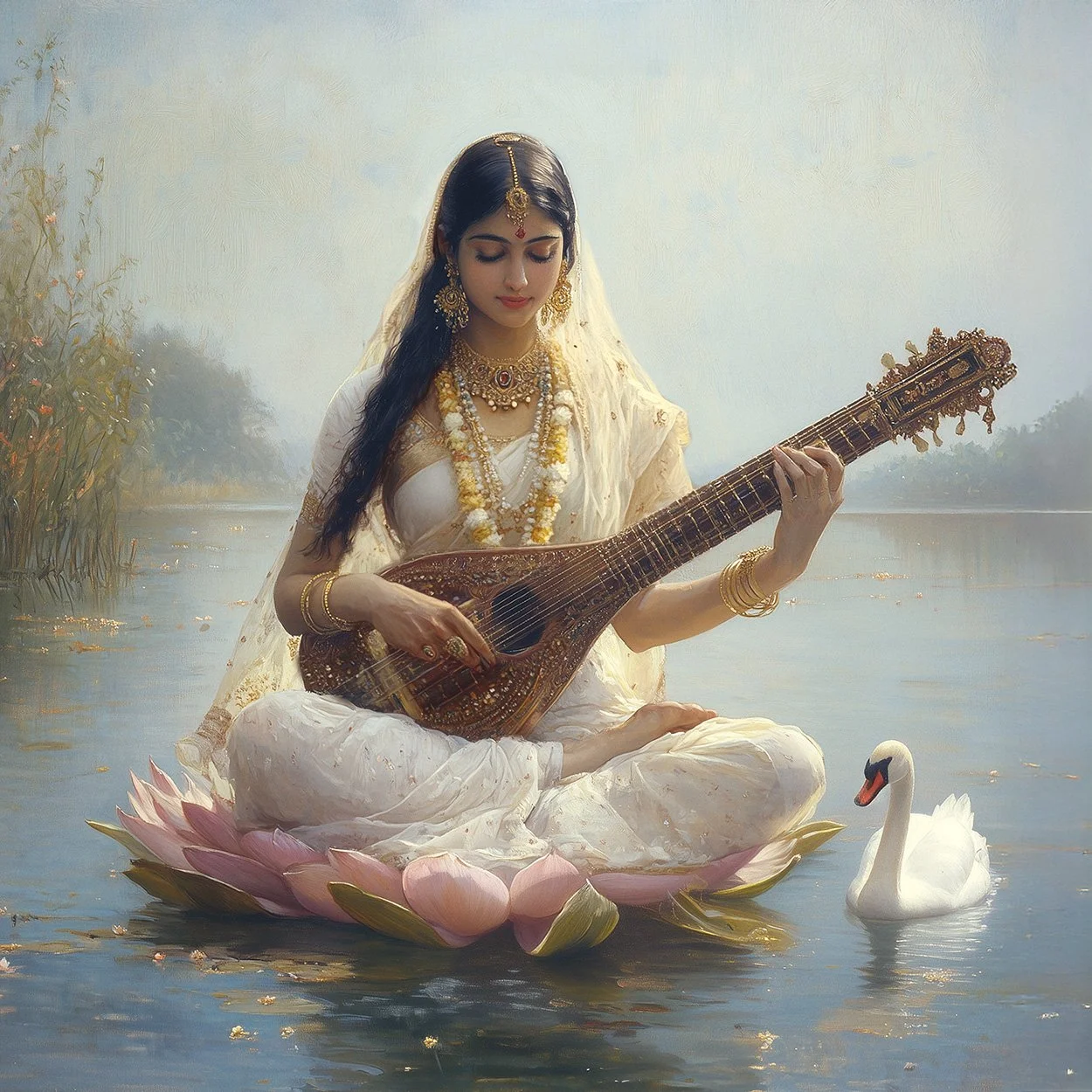
As the quiet of late Winter begins to soften and the first hints of Spring rise beneath the surface, the world enters a Season traditionally devoted to clarity, creativity, and new learning. It is during this threshold between dormancy and renewal that the Hindu goddess Saraswati is especially honored, for she presides over wisdom, music, speech, and the gentle flow of inspiration. Her festival, Vasant Panchami, marks the beginning of Spring in India and is dedicated to the pursuit of knowledge, creativity, and auspicious beginnings. Saraswati’s name means “she who flows” or “she of the stream,” a reference not only to water but to the living current of insight, language, and consciousness that she brings into the world. She is the personification of the sacred spark that awakens the mind and stirs the soul toward expression. Saraswati’s very essence embodies the stream of insight, clarity, and creative flow that nourishes the mind, body, and spirit.
Saraswati isn’t as widely known outside Hinduism, perhaps because her power is more reserved, subtle, and internal. She is a quiet force, more demure and mindful, but no less vital or revered within her domain. She is widely venerated in Hindu culture, especially among students, artists, musicians, writers, and scholars, as the patroness of speech, wisdom, and creative expression. Saraswati represents eloquence and elegance, refinement and discernment, thoughtfulness and intellectual vigor.
In Hindu cosmology, Saraswati is born from the thoughts of Brahma, the creator god at the beginning of time. In some versions of the myth, she becomes his consort, inspiring him to shape the formless into form through the power of knowledge and speech. One thing that I find so beautiful in Hinduism is that for every powerful male deity, there is a female to balance out the masculine. In cultures that diminish or remove the feminine altogether, I have so much affection for traditions that truly understand the importance and power of the feminine as equal to and just as important as the masculine, even if the masculine are the primary focus. In this way, with Brahma, Saraswati brings order to chaos in her gentle way, language to silence, and intelligence to raw matter. Without her, creation would remain inert, a potential never awakened. She brings the creativity to creation, with knowledge, music, speech, writing, art, and human expression in its most primal and natural form.
There is another version of the story that highlights Saraswati’s independent strength. According to this myth, Brahma becomes infatuated with her and begins to pursue her obsessively. Saraswati, embodying self-possession and clarity, is said to have rejected his advances and ascended into the sky to escape. As she moved, he created eyes in every direction to follow her, which is why he is sometimes depicted with four heads. This myth, less romantic and more obsessive, reminds us that wisdom must never be controlled or objectified. Saraswati does not belong to anyone. She flows where she is honored and leaves where she is not.
She is also said to have once been a great river, sacred and flowing, her waters nourishing the land and people of ancient India. Some traditions say she went underground, retreating into the unseen when humans began to misuse her gifts. This image is rather poignant, suggesting that when we neglect or exploit wisdom, inspiration does not vanish. It simply goes quiet, waiting to be rediscovered with respect and reverence.
While she is revered and venerated by scholars, artists, and musicians, she is especially honored during the festival of Vasant Panchami in late January or early February, which marks the beginning of Spring and is dedicated to learning, music, and the pursuit of knowledge. On this day, devotees of Saraswati wear yellow or white, offer the goddess flowers and sweet treats, and place books, instruments, and tools of their trade at her feet in devotion.
Saraswati’s iconography is both poetic and fitting for her role as a goddess of learning, as well as the consort of Brahma in some traditions. She is typically depicted seated on a white lotus, symbolizing purity and spiritual transcendence. Dressed in flowing white garments with touches of yellow and pale blue, she holds the veena, a traditional Indian stringed instrument that represents harmony, rhythm, and creative expression. The veena requires both technical skill and emotional sensitivity to play well, much like the practice of art or the path of knowledge itself.
In her other hands she is often shown carrying a book, usually the Vedas or a palm-leaf manuscript, and a string of prayer beads, reminding us that true wisdom is achieved through both nurture and nature, that it can be studied or felt, both spoken and silent. Her vahana, or sacred vehicle, is the elegant and graceful swan, known in Indian mythology for its legendary ability to separate milk from water. Of course, this is not a literal trait, because that would be weird. It is a Hindu metaphor, a symbol of viveka, or spiritual discernment, the capacity to distinguish truth from illusion, essence from excess. In this interpretation, the swan becomes a living reminder that wisdom is not just about what we learn, but how we see, what we choose to absorb, and what we let pass through. Sometimes Saraswati is also shown with a peacock or near a stream, drawing her even closer to beauty, flow, and the ever-evolving rhythm of the arts. And again, these birds are both known for their dignified elegance, beauty, and gentleness, in theory. Anyone who has ever crossed paths with any sort of goose relative knows they lean toward violence.
Saraswati’s essence transcends religion. She represents something universal, the sacred current of understanding, the gentle presence behind all true learning and meaningful self-expression. Her gifts are not loud or dramatic, but they shape our lives in profound and lasting ways. To invoke Saraswati is to invite grace into our minds, clarity into our voices, and harmony into our creative work.
Other cultures echo her archetype in their own pantheons. The Greek goddess Athena shares her sharp intellect and disciplined artistry. Brigid of the Celtic traditions, patroness of poetry and inspiration, reflects Saraswati’s creative fire. In Japan, Saraswati evolved into Benzaiten, a goddess of eloquence, music, and flowing water. And in Gnostic traditions, Sophia represents divine wisdom itself, the feminine soul of the cosmos, which whispers truths not easily spoken.
If you plan on working with her in your own spiritual practice, she’s beautifully attuned to those pursuing artistic or academic paths like writing, painting, composing, researching, teaching, or studying. Saraswati guides the creative life force that flows through us all. She is the embodiment of shakti in its most refined, sattvic form, offering not just inspiration, but clarity, balance, and sacred expression. In every culture, there seems to be a goddess who protects the flow of knowledge, beauty, and expression, who reminds us that the mind and the heart were never meant to be divided. Saraswati is that reminder. She is the muse behind the poem, the silence beneath the song, the white space on the page before the first word arrives. She does not shout to be heard. She waits to be honored.