Imbolc & the Full Snow Moon in Leo
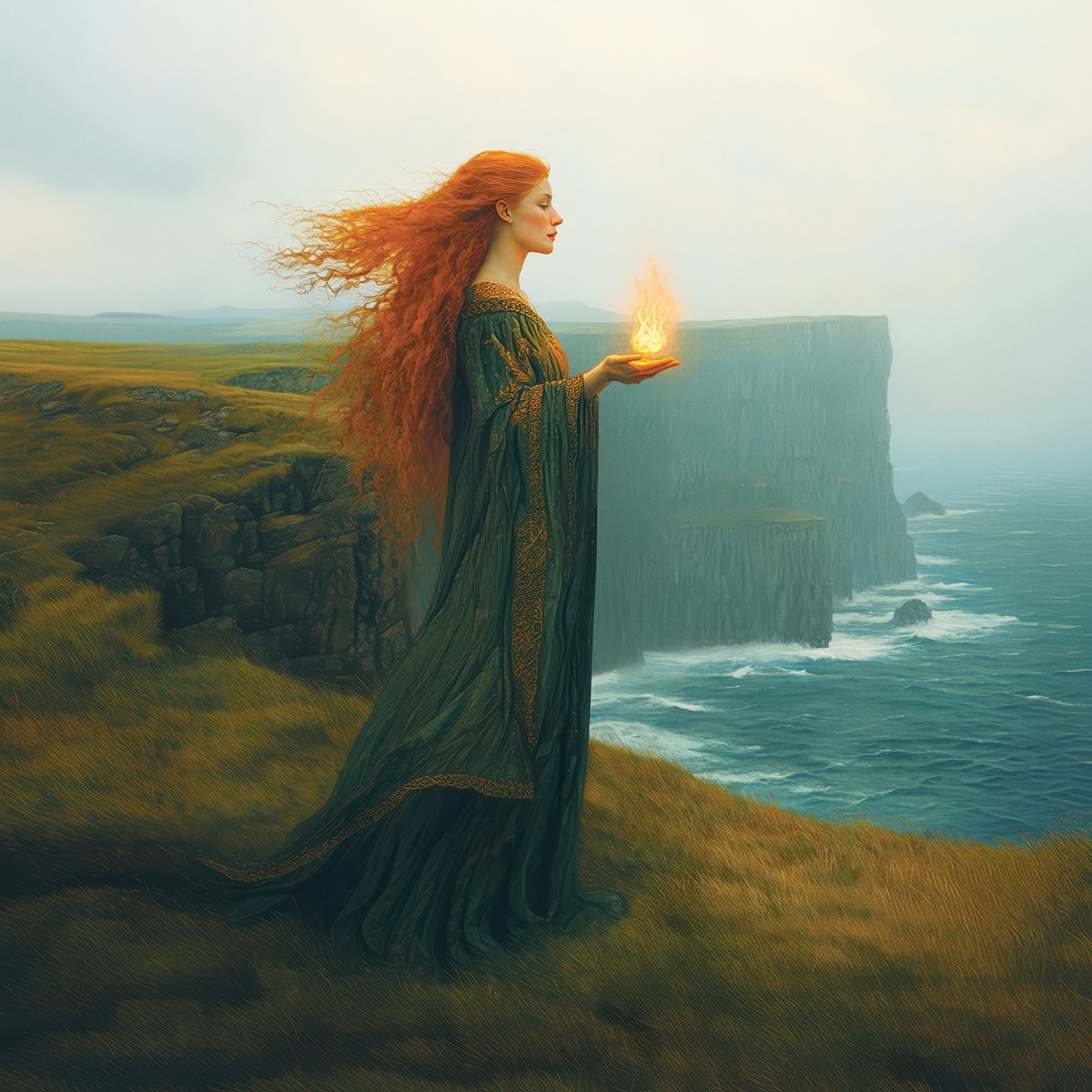
January is winding down, and in just a few short days it will be February 1st, bringing with it the fire festival of Imbolc as well as the Full Snow Moon in Leo. Honestly, I love when the Wheel of the Year aligns with the lunar cycle. It feels like a cosmic synchronicity you just cannot ignore, especially when both the Leo Full Moon and Imbolc represent fire, a striking contrast to the frigid cold we expect from February. Something about it feels more magical and mystical. All of this amplifies themes of rejuvenation, rebirth, and the first stirrings of a new world on the horizon.
But this isn’t just a poetic overlap on the calendar. It’s a meeting point between two different kinds of fire. Imbolc brings the quiet, sustaining flame of hope, patience, and devotion, the hearth fire that keeps life going when resources are scarce and the future is still uncertain. The Leo Full Moon brings a brighter, more expressive fire, one that illuminates desire, creativity, and the need to take up space as an individual. Together, they tell a deeper story about this moment in the year. Endurance alone is not enough for survival. We also need hope, purpose, and courage.
The Snow Moon, the Hunger Moon, and the Fire of Leo
The Full Moon rises around February 1st in the sign of Leo, illuminating areas of our lives connected to desire, creativity, confidence, and leadership. Leo is the bold, charismatic type, the popular quarterback and theater kid who knows how to command a room and doesn’t shy away from the spotlight. In astrology, Leo tends to rule sexuality, creativity, and self-expression, so those themes may feel especially prominent during this lunation. At its core, this Leo Full Moon reminds us that life isn’t only about getting through hard seasons, but about remembering what makes us feel alive, fulfilled, and connected to our own sense of purpose. Leo invites us to be selfish in a good way, so we’re not just surviving, but actively building a life with our whole heart, especially during times when the world feels chaotic or emotionally on fire.
In astrology, Leo and Aquarius sit opposite each other in the zodiac, forming an axis that explores the tension between individuality and the collective. Leo represents the personal self. It rules self-expression, creativity, pride, and the need to be recognized for who you truly are. Aquarius represents the collective. It governs groups, systems, ideals, and the future, often prioritizing the cause, the vision, or the bigger picture over any one person. There is a reason that Leo is represented by the Lion and Aquarius is the water bearer—both symbols allude to their archetype within the zodiac.
When this sacred tension is out of balance, Leo can become overly focused on attention, ego, or validation, while Aquarius can drift into emotional detachment or dismiss lived reality in favor of concepts and ideals. When balanced, they work beautifully together. Leo brings heart, warmth, passion, creativity, and humanity to the collective. Aquarius gives Leo purpose beyond ego, helping it serve something larger than itself. Under this Full Moon, personal feelings and creative desires come into focus, but they do so in tandem with an Aquarian sense of responsibility, community, and the future we are helping to shape. Leo energy asks to be seen, appreciated, and respected. It asks us to take up space honestly, without apology. Aquarius, on the other hand, tends to express individuality through innovation, intellect, and collective ideals rather than personal spotlight, caring more about the apparatus than the applause, reminding us that tending our inner fire is part of how we show up responsibly in the world.
This Leo Full Moon arrives alongside Imbolc and right at the edge of the first Eclipse Season of the year, with the next New Moon and the March Full Moon both unfolding as eclipses. Because of that, what’s showing up now isn’t asking to be resolved or neatly tied off. It’s asking to be noticed. Like seeds stirring beneath frozen soil, something is waking up, even if you can’t quite name it yet or see where it’s headed. The Leo Full Moon tends to shine a light on the parts of your life that have been quietly asking for your attention. Maybe there’s a truth you’ve been sitting with that suddenly feels harder to keep to yourself. Maybe a creative spark you thought had gone quiet starts nudging you again, asking for room to breathe. Or maybe a role you’ve been playing out of habit or obligation just doesn’t fit the way it used to. Nothing has to explode or dramatically change overnight, but something becomes clear. The feeling isn’t chaos. It’s clarity, warmed by that steady Leo heat that says, this matters now, and you don’t have to carry it all alone.
In Native American and Folk traditions, the Full Moon of February has been known as the Snow Moon. This was often the coldest and snowiest part of the year, when deep drifts made travel difficult and survival more precarious. In some traditions, it was also called the Hunger Moon, a stark acknowledgment of scarcity after months of cold. By this point in Winter, survival depended on restraint, strategy, and pragmatism. Stored food was running low, hunting was difficult, and patience was essential. Just trying to get into my car required about 3 hours of shoveling so I could go visit a nice, warm grocery store and grab some snacks and sweets for my snowstorm micro hibernation. It’s hard to imagine what our ancestors endured, hunting through frozen forests and trekking through a foot or more of ice-covered snow in the hope of finding something, anything, to eat in order to survive, knowing there were still weeks of bitter cold ahead. The Snow or Hunger Moon doesn’t romanticize the cold or soften the reality of Winter’s brutality. It names it honestly. It asks for endurance, steadiness, and a clear sense of what truly matters, including where we place our energy and attention. When the world feels overwhelming or emotionally on fire, this moment asks us to pause and consider what we’re feeding within ourselves, because how we tend our inner fire shapes how we move through the collective.
February carries a surprising amount of fire energy in the midst of cold and ice thanks to the convergence of Imbolc and the Leo Full Moon, along with several planets moving through fire signs, like Neptune in Aries. To me, this feels like an invitation for a little more playfulness and courage, and a chance to step back from carrying the weight of the world, a reminder that joy and creativity are not indulgences, but necessary sources of vitality. This is a time to reconnect with confidence, to empower creativity, and to remember that fun and self-expression are part of how we survive.
And that’s why the fire of Leo feels so meaningful now. Fire doesn’t deny the cold. It answers it. This lunation reminds us that even in the leanest stretch of Winter, vitality still exists, waiting to be claimed. Something is preparing to be born. We’re just beginning to feel its warmth, and how we tend that fire will shape what we carry forward.
Imbolc
Coinciding with this year’s February Full Moon is Imbolc, one of the four great Celtic fire festivals. Traditionally observed around February 1st, Imbolc marks the midpoint between the Winter Solstice and the Spring Equinox. It isn’t a solar festival or a harvest festival, but instead represents the return of life, when what has been sleeping deep underground begins to stir beneath the soil. For myself, Imbolc marks the beginning of Spring, even if we won’t begin to see these stirrings for at least a few more weeks. This is the time of year when it is often the coldest, with deep snow and ice lingering before the March thaw begins. Imbolc marks the end of Winter’s dominance, not the arrival of Spring as we know it. The land is still cold and unyielding on the surface, but something has changed. Beneath the snow and ice, the ground begins to awaken. Roots start to awaken, sap begins to move, and Autumn seeds scattered by wind and wildlife, buried deep, begin to grow, relying on the darkness as their midwife.
The name comes from Old Irish imbolg, usually translated as “in the belly,” referring to pregnant ewes and the first signs that the land is again capable of producing life. This wasn’t abstract symbolism, but an agricultural reality. This was the time of year when food stores were dwindling and the promise of a bountiful Spring and Summer wasn’t guaranteed. The coming lambs represented hope that life could continue, that the Wheel would keep turning. And for me, there is something so primal and visceral about “in the belly” that really hits home.
Imbolc is a fire festival, but unlike other points on the Wheel of the Year that celebrate with roaring bonfires and communal spectacle, Imbolc’s fire is quieter and more intimate. The fire here lives in candles rather than flames visible for miles. It is the hearth fire, the bedside flame, the single light kept burning through the coldest nights. This is not fire meant to impress or conquer, but fire meant to sustain. Fire that warms the body, protects life, and offers just enough light to keep going when Winter has not yet loosened its grip.
This kind of fire speaks to patience, care, and devotion. It honors the small, steady acts that keep life alive long before growth is visible. At Imbolc, fire is not about celebration for its own sake. It is about survival, hope, and trust that what is quietly stirring beneath the surface will, in time, find its way into the light.
This is a time of awakening and rebirth. “In the belly” applies to more than just livestock. It is the hum of life waiting patiently underground to be born again. And since humans are a part of nature, not apart from it, we can hold this as sacred, a time for our own rebirth, knowing that Spring is on the horizon. This is why Imbolc is a festival honoring the return of the fire, a time to remember hope, patience, and purpose.
Brigid
It wouldn’t be Imbolc without mentioning the Celtic figure of Brigid, who is central to this celebration. Brigid, as you may recall from my earlier posts, is one of the most multifaceted goddesses in mythology, governing fire, creativity, craftsmanship, healing, fertility, poetry, and truth, just to name a few. In some later traditions and symbolic interpretations, Imbolc marks a time when Brigid is said to transition from a Winter persona associated with the Cailleach into the youthful form we know and love, reinforcing her role as a threshold deity. In this telling, the Crone begins her descent as the Maiden returns. This kind of symbolic thinking echoes themes found in the myth of Persephone and her return to the land of the living. And that’s why this Full Moon feels particularly threshold-y for me. Lots of fire and rebirth energy, despite the frigid temperatures outside.
As a goddess most associated with fire, Brigid wasn’t about wildfire or chaos, but about the fire of life itself. A fire that is contained, tended, and sustained. This sacred fire lives in the hearth, in the forge, and in the quiet twinkle of candlelight that keeps us warm, ready, and able to see through the darkness as life waits for Spring. And when a Full Leo Moon falls on the same day as Imbolc, we meet an equal but different kind of fire, one that stokes creativity, passion, love, and self-expression. Imbolc reminds us that warmth is something we preserve. Leo reminds us that warmth is also something we express.
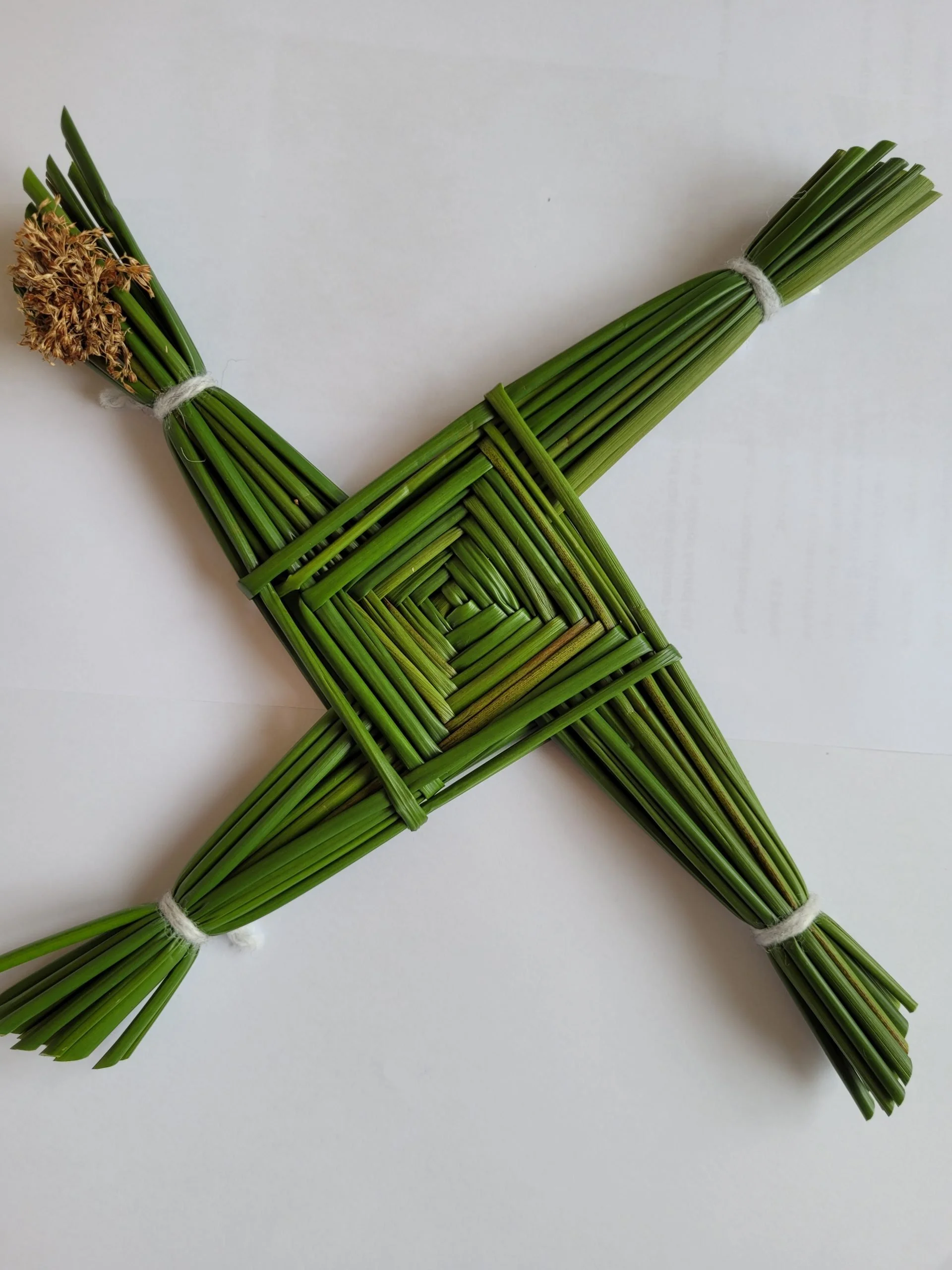
Brigid governs the moment when something crosses from potential into being. That is exactly what Imbolc represents. “In the belly” is no longer an abstract idea, but a physical reality that required care and tending to survive. Sacred wells were cleaned at this time. Candles and hearth fires were rekindled in her honor. Brigid’s crosses and woven figures were made as protective talismans for the coming agricultural year. Seasonal customs reflect a belief that this was a time when people could influence the coming season through preparation, divination, and ritual. Communities gathered to bless seeds, tools, homes, and livestock in hopes of a prosperous and peaceful growing season.
Put yourself in the humble shoes of an ancient Celt. There was no food delivery, no stocked shelves, no comfort shows to watch while the wind howled and the earth lay frozen. You planned. You prepared. You asked the gods to bless you, not for wealth, but for enough. Enough food. Enough warmth. Enough life to endure. Survival was never guaranteed, so prayer, faith, and ritual became shared acts of hope. Imbolc wasn’t just a fire festival. It was a celebration of survival itself. Fire here is more than the spark that starts life in the belly. It is life-sustaining.
Like many Celtic festivals, Imbolc didn’t vanish when Christianity arrived. It shifted. February 1st became St. Brigid’s Day, honoring Brigid of Kildare, an early medieval saint whose story carries clear echoes of the older goddess. In Irish Catholic tradition, Brigid stands alongside Saint Patrick and Saint Columba as one of the most beloved saints, and the fact that her feast day falls on Imbolc feels anything but accidental. Rather than wiping the slate clean, Christianity seems to have worked with what was already there, giving familiar symbols a new religious frame. Fire, healing, fertility, hospitality, poetry, and the protection of livestock all remain central to St. Brigid’s stories, mirroring the domains long associated with the goddess almost one for one.
Her monastery at Kildare takes its name from Cill Dara, meaning “Church of the Oak,” a tree already sacred long before Christianity reached Ireland. Even the land itself held memory. And then there’s the flame: a fire said to have been kept burning there by a community of women for centuries. Not a metaphorical flame, but a real one, tended daily, passed from hand to hand, and closely associated with Brigid herself. It feels like a natural continuation of older hearth and fire traditions tied to Imbolc and renewal. In this way, Brigid of Kildare becomes less a replacement and more a bridge, holding together goddess and saint, pagan and Christian, ancestral ritual and evolving faith. Her enduring connection to fire and February 1st reinforces Imbolc’s deeper meaning as a threshold moment, shaped by continuity rather than rupture.
Working with Imbolc and the Leo Full Moon
Imbolc has long been a moment for quiet divination. Traditionally, this was a time for watching the weather, tending sacred wells, reading small signs, and preparing the home and tools for the coming season. Brigid’s presence here favors simple acts done with intention: lighting candles, cleaning a space, blessing seeds or plans, and listening for what is ready to emerge. You might even make Brigid’s crosses as talismans or seasonal decoration, honoring both the goddess and your ancestors who, no matter where they lived, survived extreme and often brutal conditions so we could live in relative comfort today. Gratitude, dedication, and hope are pillars of Imbolc.
The Leo Full Moon brings a complementary emphasis. Where Imbolc asks us to notice what is stirring, Leo asks us to claim it. This is an excellent lunation for heart-centered reflection: journaling about what you want to create this year, naming where you want to be seen more fully, or acknowledging desires that feel too alive to ignore. Many astrologers associate Leo Full Moons with creative release, confidence-building, and honest self-expression, especially around joy, romance, and personal leadership.
Blended together, these energies suggest a simple approach. Begin with Imbolc’s patience. Tend the flame. Notice what’s waking up. Then let the Leo Full Moon add warmth and courage. Speak something aloud. Make something visible. Take one small action that honors what has been quietly growing beneath the surface. This isn’t about forcing outcomes. It’s about giving life enough heat to keep unfolding.
There is something deeply Imbolc-appropriate about a Leo Full Moon rising during the Hunger Moon. Fire does not deny the cold. It answers it. In the depth of Winter, under a Moon once called the Hunger Moon, this Leo fire reminds us that even now, something is preparing to be born. We’re just beginning to feel its warmth.