July Astrology Guide
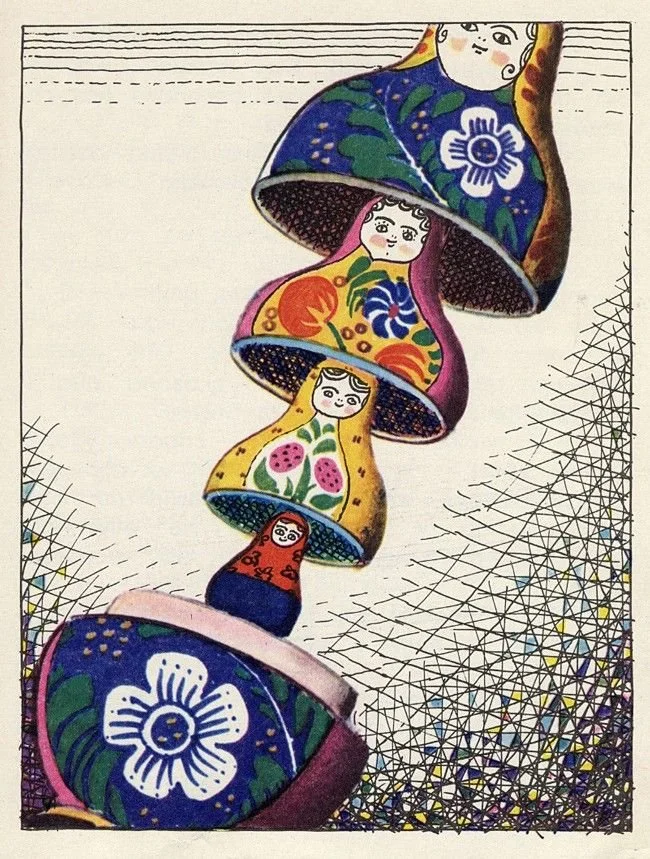
Lev Tokmakov for Katya Toy City, 1973
Astrologers, mystics, mediums, and esoteric thinkers from remarkably different traditions seem to agree on one thing: July marks a threshold. If you’ve been following astrology over the past year, that probably shouldn’t come as much of a surprise. We’ve already crossed several major turning points. Neptune entered Aries for the first time in more than 160 years, with Saturn following close behind, Pluto had already settled into Aquarius, and more recently Uranus moved into Gemini. Add the symbolism of 2026 as the Year of the Fire Horse and a Universal Year One in numerology, and it begins to feel as though the universe has been quietly laying one stepping stone after another, leading us step by step toward the realization that the world around us is changing. The map is there, we just have to look to the stars.
Every astrological event seems to compound the next one, interconnecting and intersecting like the warp and weft of a fabric, creating a larger tapestry that we can’t fully make out until the weaving is complete. The past few months have reminded me of Russian nesting dolls. Once you open one, you discover another inside. And it just keeps going. Mid-July feels like another one of those moments.
Astrologically, we begin moving from the cardinal waters of Cancer, the sign of the mother, the home, and the emotional roots that nourish us, toward the fixed fire of Leo, the sign of creative life force, identity, courage, and the willingness to be seen. Before we step into the light, we first return to our roots.
That alone would make July esoterically interesting, but there is another reason so many astrologers have been watching this particular stretch of time.
André Barbault and the Bigger Picture
One name keeps surfacing whenever July 2026 enters the conversation, and that is famed French astrologer André Barbault. Among astrologers, Barbault is held in almost legendary regard, particularly within a branch of astrology known as mundane astrology. The first time I heard about mundane astrology, I was a bit confused, considering the colloquial meaning is ordinary, routine, lacking interest or excitement to the point of banality. But here, mundane comes from the Latin mundus, meaning “the world.” Instead of focusing on individual birth charts, mundane astrology studies the larger cycles of civilizations, governments, economies, technological breakthroughs, cultural movements, and history itself. This is big-picture astrology with a somewhat misleading name.
André Barbault, who passed away in 2019, spent decades studying the long rhythms of history, comparing planetary cycles with wars, economic upheaval, political change, and periods of cultural renewal. One reason his name has experienced a resurgence in recent years is that many astrologers revisited his work after the pandemic. Decades earlier, Barbault had identified the early 2020s as a period of exceptional global crisis, which has led many to connect the dots toward the pandemic. I think we can all agree 2020 was a major shift, and I often refer to life as B.C. and A.C. Before Covid, After Covid because life has changed so much since then. But back to Barbault, who believed that just as individuals experience seasons of growth and challenge, civilizations move through cycles as well.
One of his best-known contributions was the Planetary Cyclic Index, a method for tracking the changing angular relationships among the outer planets over time (in astrology, this simply refers to the angles planets form with one another, like conjunctions, sextiles, squares, trines, and oppositions). Looking backward through history, Barbault believed periods when these planets clustered into tense configurations often coincided with collective crisis, while more harmonious arrangements tended to accompany periods of reconstruction and renewal. Long before 2026 was on anyone’s radar, Barbault identified the early 2020s as a period of exceptional global tension, followed by the beginning of a more constructive cycle around the middle of the decade.
It’s important to make one distinction because, all too often, astrology can veer into predictive absolutism. My preference is to look at it as a tool, much like the map analogy I mentioned earlier. Barbault didn’t predict that “something big happens in July 2026.” That idea is a modern interpretation of his work. What he identified was the larger planetary cycle. Contemporary astrologers, including Pam Gregory, have simply noticed that many of the exact alignments Barbault considered important become tightly concentrated throughout July, leading some to affectionately refer to the pattern as Barbault’s Basket, a modern tribute to his work rather than his own terminology.
Many of these exact alignments occur at approximately 4° of their respective signs: Neptune in Aries, Uranus in Gemini, Jupiter in Leo, and Pluto in Aquarius. Astrologers often pay close attention when several slow-moving planets occupy the same degree and form exact aspects with one another because their themes become unusually concentrated and interconnected. If you have planets or angles near 4° of these signs, you may experience this period more personally.
Whether history ultimately remembers July as a turning point remains to be seen. What makes it fascinating is that so many different planetary cycles begin overlapping at the same time. And like those Russian nesting dolls, each layer reveals another.
July 12 | Mercury Cazimi in Cancer
The next Russian nesting doll arrives with a Mercury cazimi. This cazimi happens when Mercury moves into the heart of the Sun, traditionally symbolizing a moment of exceptional clarity, insight, or understanding. Because Mercury is retrograde, that clarity often comes through reflection and introspection rather than new information or anything necessarily external. Cancer brings the focus back to home, family, memory, ancestry, emotional security, and the stories we carry about where we belong. You may find yourself feeling nostalgic, reflective, or unable to shake something from childhood, adolescence, or your more recent past that is asking for some attention.
For me, I’m noticing that my perspective has shifted, especially after last month’s Sagittarius Full Moon. So anything from my past that’s tapping me on the shoulder, particularly around the themes of Cancer and Mercury, I’m revisiting through a different lens than I did the first time around, or even during subsequent revisits. This feels like an invitation to reconnect with our roots, clear out any stuck energy, and make space before we move forward.
July 14 | New Moon in Cancer
Normally, I like to give the New Moon and Full Moon their own essays, but here, this New Moon in Cancer feels like it’s very connected to the surrounding astrology like the threads in the July section of this universal tapestry, so it doesn’t feel right to observe it in a vacuum. As you know, every New Moon begins a new lunar cycle. New Moons are starting points, the place where you plant the seeds you’ll reap with the harvest of a Full Moon culmination. Could be two weeks, two months, or two years, but the cycle is the same. Because Mercury remains retrograde, this feels less like planting something entirely new and more like tending the soil before the next season begins.
In Cancer, that beginning is deeply personal. Rather than asking what we want to accomplish, Cancer asks what we need in order to feel nourished, supported, and emotionally secure. Cancer carries big mother energy, so if this feels like rumination in the womb of the psyche, that tracks. This is an opportunity for an emotional reset where we can heal old emotional wounds, break unhealthy or toxic patterns, and create stronger foundations around what home and family mean to us.
July 18-21 | The Barbault Basket
And four days after the New Moon, we have a four-day period nearly every astrologer and mystic has been talking about. Within just a few days, several major outer-planet aspects become exact. Rather than explain every aspect individually, it’s easier to think of them as musicians in an orchestra. Each has its own sound, its own timbre and quality, but together they create something larger than the sum of their parts. Sometimes the result is harmonious, and sometimes it’s cacophony. Like any orchestra, the beauty emerges not from a single instrument, but from the way they respond to one another. How that ultimately plays out depends on both the larger collective cycle and where these transits touch your own chart. Mundane astrology helps us understand the season we’re living through. Our natal chart helps us understand how we, as individuals, experience that same season.
To make it easy, I’ve bullet-pointed the events below:
Uranus trine Pluto
Uranus sextile Neptune
Jupiter opposite Pluto
Jupiter trine Neptune
Jupiter sextile Uranus
For context, Uranus is often associated with innovation, disruption, awakening, technology, and sudden change. Pluto represents deep transformation, power, endings, rebirth, and the forces that reshape systems from the roots. Neptune brings dreams, spirituality, imagination, myth, compassion, and sometimes illusion, while Jupiter expands whatever it touches, magnifying themes of growth, belief, opportunity, wisdom, and abundance.
The relationships matter, too. A trine is generally interpreted as a supportive flow between planets, while a sextile suggests opportunity, cooperation, and potential that still asks for participation. An opposition creates tension, contrast, or a necessary confrontation between two forces. So when we look at this pattern as a whole, we are not just looking at planets sitting in the sky. We are looking at transformation, innovation, vision, expansion, power, and possibility all speaking to one another at once.
Individually these aspects are significant, but together they create an unusually coherent geometric pattern involving nearly every outer planet. This is why modern astrologers continue returning to Barbault. Most astrologers agree that this pattern supports innovation, scientific breakthroughs, cultural shifts, new ways of thinking and large-scale societal recalibration and reorganization. Which is why so many are saying this is the threshold moment, when we step into a new paradigm. From what we know about what each of these planets represents, this has the potential to be life-changing in many ways. But every birth is preceded by labor. Growth almost always asks us to release something first. So if fear, anger, grief, or uncertainty begin surfacing during this window, perhaps they’re less a sign that something is wrong than that something old is making room for something new.
July 23 | Mercury Direct & The Sun Enters Leo
And Barbault’s Basket happens at the tail end of Mercury Retrograde. Mercury stations direct just two days later. This Mercury retrograde favored introspection and emotional review, taking place in Cancer. But now, Mercury goes direct the same day the Sun enters Leo. Cancer had us swaddling our emotions and tending our roots, and Leo brings the Sun’s vitality to help grow whatever seeds we planted. The “roots” here were about home, family, and our intimate emotional landscape, and we can see this natural shift from inner security and nurturing toward healthy creative expression, confidence, generosity, leadership, and the courage to share our gifts. What feels clear after the retrograde introspection? We’ve shifted from inner yin, shadow, and nurture toward outer yang, light, and expression. This is a time for a surge of creative energy and momentum after several weeks of reflection. If Cancer was the warm, watery womb of reflection on what family, home, and relationship means to us, then Leo is bringing the heat and light of the Sun to make sure whatever work we did in the womb can grow and prosper.
July 26 | The Lunar Nodes Enter Aquarius and Leo
Just when you thought July had revealed all of its layers, another Russian nesting doll appears. The lunar nodes change signs roughly every eighteen months, quietly shifting the backdrop for the eclipses and the larger lessons that unfold over the next year and a half. On July 26, the North Node moves into Aquarius while the South Node enters Leo, inviting us to explore one of humanity’s oldest balancing acts: the relationship between the individual and the collective.
Aquarius often gets reduced to abstract thinking, innovation, technology, or humanitarianism, but at its heart, Aquarius asks how the individual participates in a healthy collective. Leo, its counterpart, asks the same question from the other direction: how do we show up bravely as individuals and share our unique gifts with the world? This is the sacred tension between sovereignty and belonging, independence and interdependence.
I heard this described beautifully in a recent ceremony with two Diné medicine people, and later found similar themes in the writings of J.T. Garrett on Cherokee philosophy. We must be wholly who we are, allow others to be wholly themselves, and then bring our gifts together. We do not serve the collective by shrinking, performing, or interfering under the guise of helpfulness. We serve it by becoming honest, clear, and fully ourselves. That feels very Leo-Aquarius in right relationship.
A community without individuals willing to think creatively becomes stagnant. An individual concerned only with personal recognition eventually loses sight of the community that helped shape them.
Like so much of July, this isn’t about choosing one side over the other. It’s about finding the balance. How do we contribute without losing ourselves? And how do we shine without needing the spotlight to validate our worth? It feels like a fitting continuation of everything Cancer and Leo have already been teaching us. We first remembered where we belong. Then we rediscovered who we are. Now we’re asked how those two truths can work together.
July 29 | Full Moon in Aquarius & Jupiter Cazimi
July closes much the way it began, by asking us to zoom out. The Full Moon in Aquarius illuminates the collective, often bringing greater perspective, clarity, and the ability to see ourselves as part of a much larger story. At nearly the same time, Jupiter meets the heart of the Sun in Leo, a rare alignment known as a cazimi, traditionally associated with heightened wisdom, confidence, generosity, and creative vision.
If Cancer was asking us to retreat inward and Leo encouraged us to rediscover our creative spark, Aquarius reminds us that our gifts were never meant to exist in isolation. The Mercury cazimi invited reflection. The New Moon asked us to strengthen our emotional foundations. Barbault’s Basket gathered together some of the most significant outer-planet alignments of the year. Mercury turned direct. The Sun entered Leo. The lunar nodes shifted into a new eighteen-month story. And now, under the light of the Aquarius Full Moon, we finally have enough distance to begin seeing how all of those individual threads may be weaving themselves into something larger.
Whether July ultimately becomes one of those months we look back on as a turning point is something only history can answer. That’s the nature of thresholds. We rarely recognize their significance while we’re standing in them. But maybe that’s the real lesson hidden inside all of these Russian nesting dolls. Rarely does one event change everything. More often, transformation arrives layer by layer, cycle by cycle, until one day we look back and realize we crossed a threshold long before we knew we were standing at its edge. Collective transformation isn’t something that happens to us. It happens through us, one person at a time.