Lunar Eclipse Full Moon in Pisces, Discernment and the Shattering of Illusions
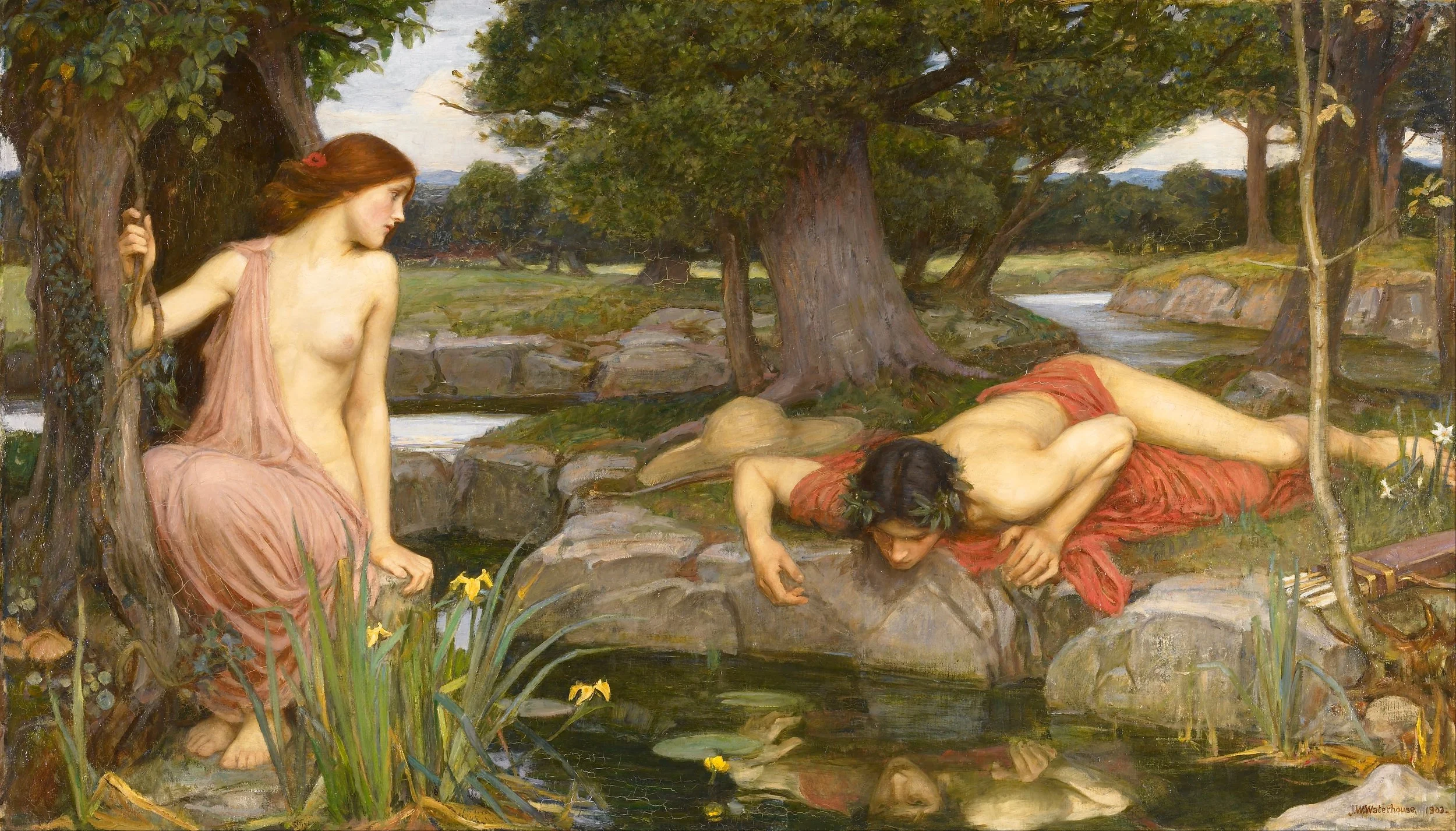
Echo and Narcissus by John William Waterhouse
This Summer comes to a close in just a few days, and with it the Full Lunar Eclipse in Pisces on August 28th, and boy, am I ready for Autumn. This Summer has been brutal on so many levels, but we’re closing in on a new season, both literally and beyond. The energy has matched the weather, dense and disorienting, heavy, overwhelming and relentless. But it’s brought about major clarity in many ways as well, since it’s forced me to really sit with the uncomfortable feelings that most of us can normally distract ourselves from long enough to forget about it for a while until it inevitably returns. That’s how reality works. We can escape it for a while, distract ourselves from it, but it doesn’t go anywhere. Reality simply is, and for me, this Lunar Eclipse is like a reckoning on how we exist in a world that’s increasingly detached from itself.
The Lunar Eclipse in Pisces opposite Virgo feels like a time of revelation. Most astrologers agree that Eclipses act like amplified moons, and depending on the signs where it takes place and the surrounding supportive astrology, interpretations vary, but most look at Full Moons as culminations, and as an Eclipse, the volume is turned up to eleven. This particular Eclipse is also receiving a very strong influence from Uranus, which is forming an almost exact square to the Pisces-Virgo axis. Uranus is associated with disruption, revelation, sudden change and breaking free from established patterns, and in Gemini, the sign of communication, information and perception, that influence feels particularly relevant. It adds another layer to an Eclipse already concerned with what we see, what we believe and what happens when new information forces us to reconsider what we thought we knew. If you aren’t a fan of long form writing, I’ll leave you with this simple word to summarize what I think this Lunar Eclipse is illuminating: Discernment.
Pisces & Virgo from a Different Perspective
The Sun just transitioned into Virgo, an earth sign associated with discernment, analysis, organization, practicality, precision, service, craftsmanship and the ability to separate what is useful from what is not. The word Virgo comes from the Latin word for virgin, or maiden, and while the ancient concept wasn’t identical to the modern idea of sexual purity, it could refer to an unmarried woman. There is an archetype here of the sovereign woman who belongs to herself, and I think that idea becomes particularly interesting when we look at Virgo through the symbolism of the harvest. Demeter, goddess of the harvest, gives us a wonderful mythological expression of that. Over time, particularly because Virgo’s season coincides with the harvest, Virgo became increasingly associated in astrological and mythological symbolism with the goddess.
Demeter, often depicted with a sheaf of wheat in one hand and a scythe in the other, determines what grows, what we harvest and what we uproot to make room for new growth. What she brings is wisdom, patience and discernment. Demeter isn’t judging to be harsh or cruel, but to determine what can grow, what is ready to be harvested and what needs to be cleared away so something new can take its place. That symbolism feels particularly powerful when juxtaposed against this Pisces Full Moon.
Pisces is symbolized by two fish swimming in opposite directions, and is typically associated with dreams, imagination, fantasy and fluidity. Pisces is the final sign of the zodiac, and as such is associated with major endings and the dissolution of boundaries, which is important to keep in mind under this Eclipse. A big part of Pisces power is the ability to remain fluid, to dream beyond what currently exists and to imagine possibilities that we can’t yet see. We need that part of ourselves. We need imagination and creativity. We need hope, especially in times like this. The ability to surrender to the unknown sometimes instead of trying to control every outcome is fundamental to human growth and flourishing because we can’t always plan or predict every outcome, and we have to be flexible enough to roll with it and adapt.
But Pisces has a shadow too. That same fluidity can become disconnection, and imagination can become escapism. Dreams can become fantasies, fantasies can become projections, and projections can eventually become indistinguishable from reality if we aren’t willing to stop and examine them. And if you’re wondering what any of this has to do with the world we’re actually living in, I think we have a pretty obvious example sitting in our pockets.
Pisces invites us to dream big, and Virgo tethers us to reality. If Pisces allows us to imagine what could be, Virgo asks us to examine what is. It’s the difference between the seed and the harvest, between what we hope something will become and what it actually is. Pisces encourages us to dream and imagine a world of possibilities, with Virgo anchoring us with discernment so that we don’t get duped by the illusions we want to believe.
So much of what we experience is filtered through perception. We see what people show us, but we also see what we project onto what they show us. We can give someone more credit than they deserve because they appear to represent something we deeply admire or wish we were, or less credit because they trigger something we don’t like about ourselves that we don’t want to face just yet, or ever. We can idealize a person, relationship or group because they reflect back something we want to believe about ourselves, and we can demonize another because they reveal something in ourselves we simply don’t want to face. We can project our hopes, dreams, fears and expectations onto relationships, situations, institutions, belief systems and even entire groups of people, good and bad, and we then act accordingly.
And I think this is part of what makes this particular moment feel so divided and disorienting. We can become so attached to our perceptions that we stop being curious about what might exist outside of them. Pisces reminds us to remain fluid and open, while Virgo encourages us to slow down and pay attention to the details. To look a little closer, question what we think we know, and remain willing to change our minds when reality gives us new information.
That doesn’t mean our perceptions are always wrong, it just means that sometimes they are incomplete. And I think that distinction matters because the invitation of this eclipse isn’t to stop dreaming or to become so rooted in reality that we lose our imagination. It’s to become more discerning about the difference between what we imagine and what is actually there. The Lunar Eclipse in Pisces is offering us the opportunity for self-examination around where we may have been fooled by our fantasies.
And this works in both directions, because Virgo has a shadow too. Discernment can become judgement, righteousness or rigidity. We can become so attached to being right, to a particular worldview, relationship, ideology or understanding of ourselves that we refuse to acknowledge new information when it shows up. We can grip so tightly to what we believe reality should be that we stop seeing what it actually is. There’s something to be said for remaining flexible when we’re moving through a period of upheaval. If you’re falling, being inflexible probably isn’t going to help you. Sometimes you have to bend so you don’t break.
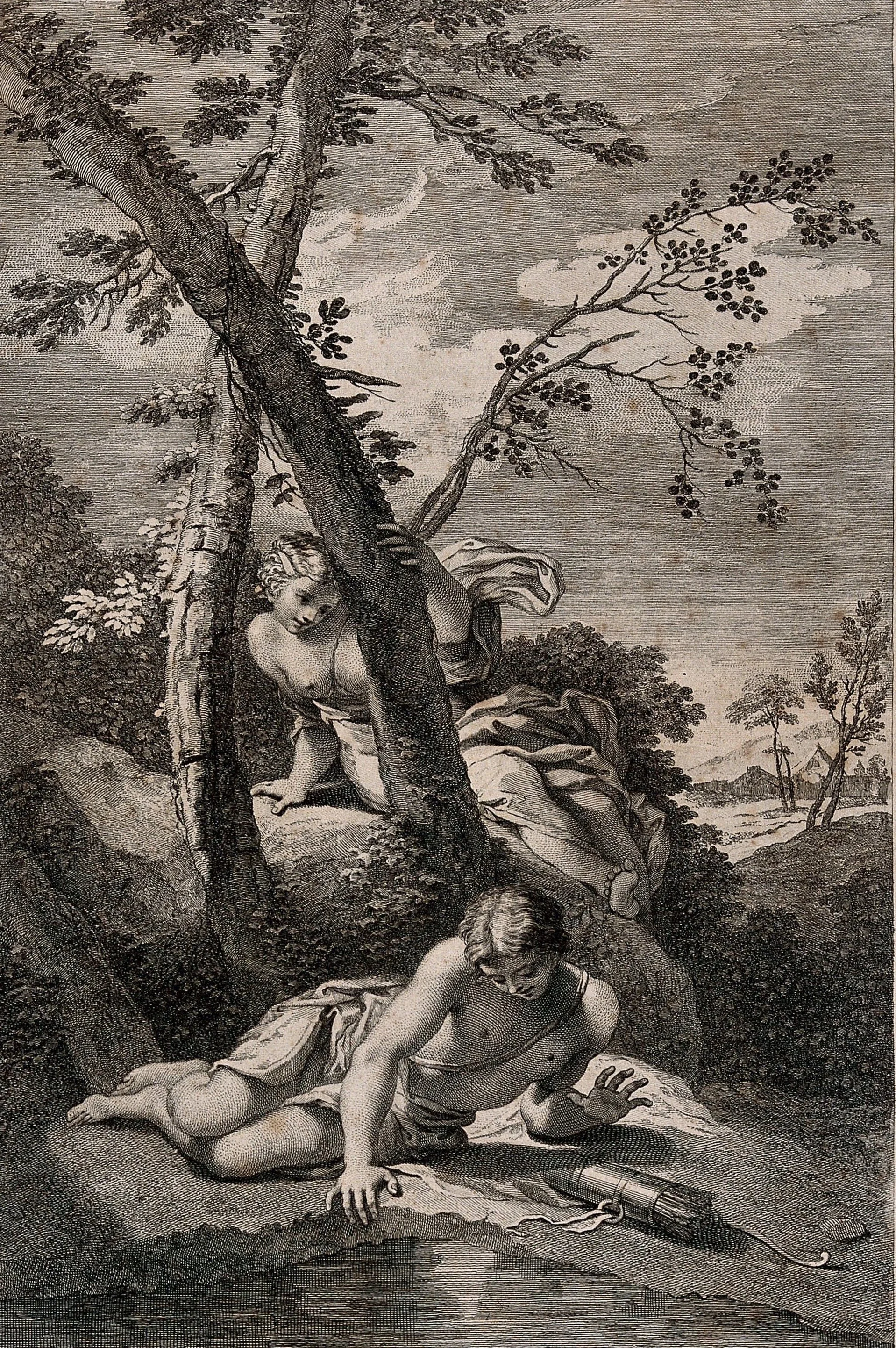
Narcissus and Echo. Engraving by F. Bartolozzi, 1791, after B. Luti.
The Mirror and the Mask
Humans have always been fascinated by reflections. We tell stories about mirrors, shadows, doubles and masks because there is something deeply human about seeing ourselves reflected back at us and then trying to figure out what we’re actually looking at.
Which brings me to the story of Narcissus.
Narcissus was so incredibly beautiful that men, women and even the gods desired him. But he was wily and independent and couldn’t be tamed. The most popular myth follows Narcissus and Echo, a nymph who fell deeply in love with him. Echo was known for her ability to tell amazing stories. She had the gift of gab, which she used on Hera, the long suffering wife of Zeus. Echo used her chattiness to distract Hera so that Zeus could enjoy himself with the other nymphs. Once she discovered Echo’s duplicity, Hera cursed Echo so she could only repeat the last words spoken to her. She stumbled upon Narcissus and immediately fell in love with him. She followed him for a while, building up the courage to approach him, but knowing she couldn’t initiate a conversation. When she finally approached Narcissus, she couldn’t speak to him, and he grew increasingly frustrated and annoyed and rejected her pretty cruelly. She was left repeating his harsh rejections. She was so distraught, she sought refuge in a nearby cave, mourning the unrequited love with fantasy of the ideal mate until she eventually wasted away, until the only thing that remained was her voice, which is where we get the word “echo” from.
Echo never truly knew Narcissus. She was captivated by his radiant beauty and created an idea of him in her head that she believed could make her happy. She was in love with what she imagined him to be, rather than who he actually was. I think we’ve all done that at some point in our lives.
Narcissus was eventually punished for his cruelty after the other nymphs prayed to the goddess Nemesis to punish him. He had been such a complete dick to so many people that eventually, karma caught up with him. One day, Narcissus found himself beside a serene lake with water so clear that he could see his own reflection perfectly. He was instantly smitten with the beautiful visage he saw staring back at him, without realizing that it was himself. But no matter how much he tried, he could never quite reach the reflection. In some versions of the story, he becomes so obsessed with trying to possess the image that he eventually drowns trying to reach it.
You can see why this myth has been relevant for thousands of years. We can become so immersed in the image that we forget there is a world outside of the water. The unsettling part is that we still haven’t learned from Narcissus, especially when we dive deeper and deeper into our own reflections and the reflections we create of other people, particularly online and through celebrity and influencer culture. Narcissus was so consumed by his desire for his own image that it destroyed him, and the story ends with his eventual transformation into beautiful flowers with delicate stems that tend to droop, giving the illusion that they are searching for their own reflection. This myth is often flattened into a much simpler allegory about vanity than it actually is. Narcissus wasn’t simply in love with himself. He was captivated by an image without understanding what he was actually looking at. He mistook the reflection for something it wasn’t and became so consumed by the image that he could no longer experience anything beyond it. The story is also where we get the modern psychological term narcissism, traits that seem to be on the rise. Hell, we even have terms like “pick me,” “clout chaser” and “main character syndrome” because people have become so enamored with the image and centrality of themselves.
This is why this myth is so remarkably relevant to the world we live in now, and not just because of social media and our increasingly screen-based lives. We are surrounded by reflections. We create them, consume them, project onto them and then sometimes forget that they are reflections at all. Social media has given us the platform to create an image of ourselves that we want others to believe or that we wish was true and begin performing for it. We can see an image of someone else and fill in everything we don’t know with our own assumptions, hopes and fantasies. We can spend hours consuming other people’s lives while barely inhabiting our own. This feels most prescient around screens, but it happens in the real world, too.
I recently had my own dissolution facing the mirror, so to speak, with a friendship I had once believed would last forever. This was someone I considered both a friend and mentor, and I had projected a lot onto the relationship. I assumed we were operating on a similar level, particularly in how we understood friendship, responsibility and integrity, and eventually I had to accept that we weren’t. I had experienced her behavior as increasingly disconnected from who I thought she was and who she presented herself to be, but a big part of me didn’t want to believe it, so I chalked it up to a misinterpretation or confusion on my end. It wasn’t. As I continued doing my own spiritual and psychological work, I changed, and I could no longer continue being the person I had been in that relationship and ignoring the red flags. I wanted an equal friendship, and she wanted me to continue orbiting her world. I had reached a point in my life where I was tired of being useful, like some side character in someone else’s life. I had hoped that if I stepped out of the role I had been occupying, and removed the utility that had become part of our dynamic, we might still be able to transition into a different kind of friendship. She ultimately chose not to, and that was heartbreaking.
I don’t think the lesson is that I was simply fooled by another person. I had participated in the projection, too. I had put someone I admired on a pedestal without realizing it and assumed we were more aligned than we actually were. Her shadow showed me things in myself that I may not have wanted to see, particularly around usefulness, performance and the ways I had connected my value to productivity and competence. Eventually, I had to look at those things honestly.
I am forever grateful for what that relationship taught me, both while I was in it and after it fractured. It taught me not to pedestalize anyone, not to diminish my own light to keep the peace, that I don’t want my friendships to feel vertical or hierarchical, and that being overly useful isn’t actually helping anyone in the long run. I had my own mirror that I wasn’t seeing the full picture in, and the reflection wasn’t the entire story. But I pulled back and looked with clearer eyes, even when it was uncomfortable, and I’m glad that I did. I faced the mirror with honesty and clarity, knowing on some level that the moment I did, the mirror would shatter. The important part is being willing to look.
And this all happened this Summer, during some of the most intense astrology we’ve experienced in a long time, and between the Eclipses, I’ve made my peace with the reality I hadn’t wanted to see. Watching everything unfold while also moving through this astrology has given me a completely different perspective on what astrology can actually be. It isn’t just about predicting what might happen. It can be a tool for self-examination and discovery, a language that gives us another way to look at what we’re already experiencing and notice patterns we might otherwise miss. The astrology didn’t tell me what was happening. It gave me a framework for understanding what was happening, and sometimes having the right framework is enough to finally see something clearly.
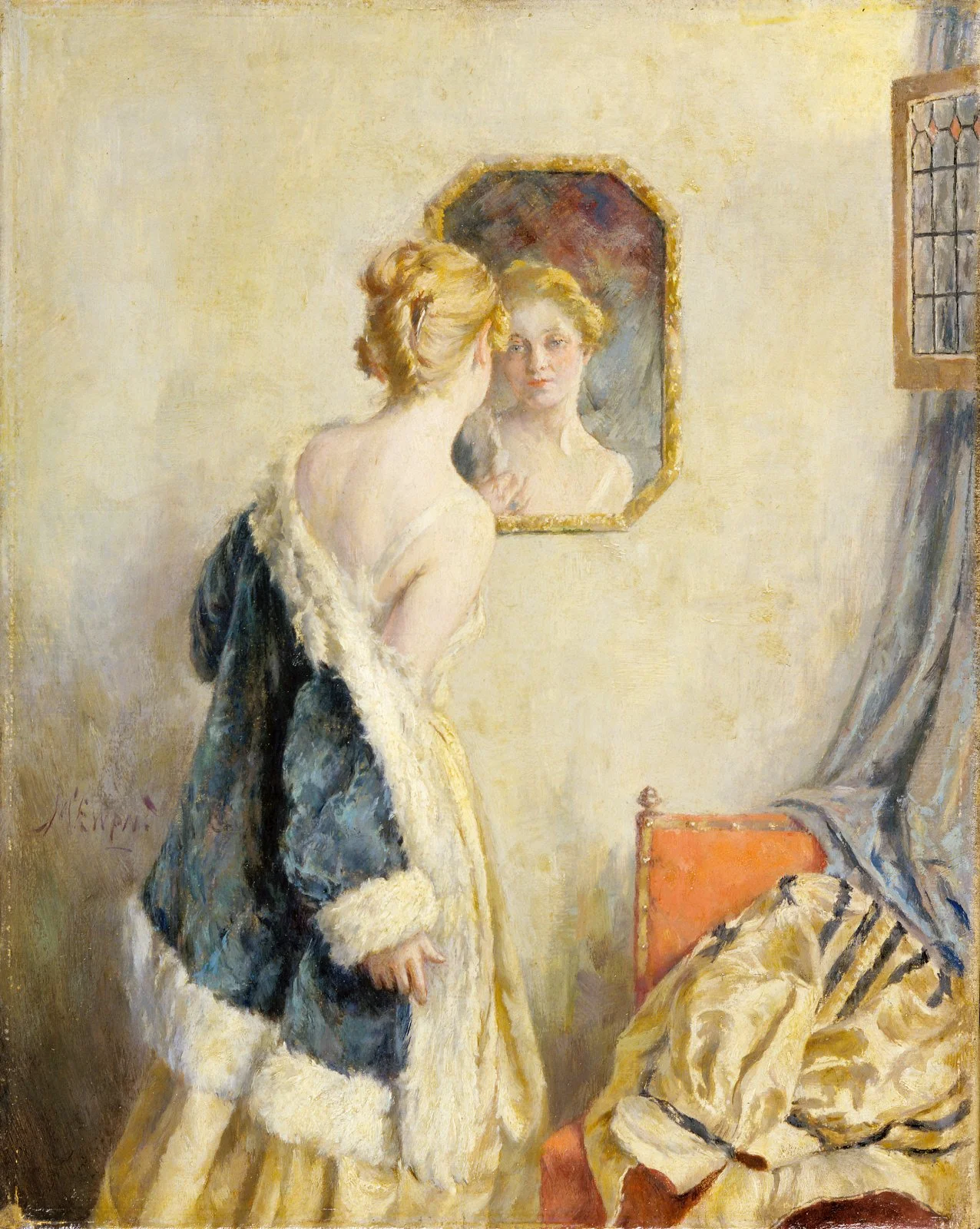
A Girl Looking in a Mirror by Walter McEwen
Reflections & Reality
And I think that’s a really important question worth asking during this eclipse season: What are we actually looking at? Is it a person, or the archetype we’ve created around them? Is it reality, or our projection of reality? Is it something that is actually nourishing us, or simply something we have become accustomed to consuming? I don’t think the answer is to stop looking into the water, so to speak. Reflection can be incredibly valuable. Sometimes we need the mirror, the archetype, the story, the image, the dream. They can show us things about ourselves that we might not otherwise see. That’s one of the reasons I love mythology, psychology and story so much. But eventually, we have to look up. There is a whole world beyond the reflection.
We do this all the time. We create images of ourselves and other people in our minds, and then we begin relating to those images as though they are the whole person. We can create an archetype of the wise teacher, the perfect partner, the righteous person, the villain, the victim, the authority, the spiritual person, the good person, the bad person. Sometimes those archetypes help us understand the world, but they can also become another kind of mask. We stop seeing the person underneath and start seeing the role we have assigned to them.
And when people inevitably show us that they are human, with flaws and contradictions and complexities that don’t fit neatly into the image we created, we can be disappointed, sometimes devastated. We can even become punitive toward the very people we once admired and helped elevate. There is something fascinating about how quickly we can build people into symbols and then just as quickly tear them down when they fail to live up to the version of them we created.
Social media has made this particularly complicated because we now live surrounded by representations of other people. We see the version they choose to show us, while simultaneously choosing the version of ourselves we want other people to see. We curate photographs, opinions, experiences, identities and entire little windows into our lives, and then we consume everyone else’s curated windows right alongside them.
We are essentially surrounded by mirrors. And the strange thing about a mirror is that it can show us something real while still never showing us the whole thing. That is the real danger of the reflection. It doesn’t necessarily have to be false to mislead us. It can contain something true while still being incomplete. The person may really be beautiful. The relationship may really have been meaningful. The teacher may really have taught us something. The image may really reflect something we admire. But none of those things necessarily tell us the whole story.
The Eclipse Revelation
This Eclipse isn’t trying to crush our dreams or destroy every illusion. Instead, I think we’re being given an opportunity to zoom out and look at reality as it actually is, rather than only through the lens of what we want it to be. That requires a certain amount of humility, because our perceptions are shaped by our experiences, our wounds, our desires, our fears and our expectations. We are never going to see the world completely objectively, but we can become more aware of what we are bringing to the picture. We can pause long enough to ask whether we are actually seeing what is there, or whether we are seeing what we have projected onto it.
That is where discernment becomes so valuable, and why it feels like the hinge point of this Eclipse. Not as a way of deciding who is good or bad, right or wrong, worthy or unworthy, but as a willingness to step back far enough to see the whole picture. This is a chance to let reality give us information, even when that information complicates the story we have been telling ourselves.
Because we can want something to be true so badly that we start treating our desire for it as evidence. We can mistake a beautiful reflection for the whole person, a meaningful experience for a healthy relationship, a compelling story for the truth. The fantasy may contain something real, but that doesn’t make the entire fantasy reality. It may simply mean we were looking at one piece of the picture and mistaking it for the whole.
I think that is the work of this Pisces Eclipse. The goal isn’t to ridicule imagination, look down on fantasy or strip the magic out of life. But we need to become more conscious of the difference between what we imagine something is and what is actually there. To look at the people, relationships, beliefs, stories and reflections in our lives with enough openness to see them as they are, rather than only as we need or want them to be. Once we can see more clearly, we can make different choices. We can stop trying to force reality to conform to the image in our heads and start responding to what is actually in front of us. We can recognize what is real, what was fake, what was partially true and what simply no longer belongs to us. We don’t have to know everything. We just have to be willing to step back, look again and let reality tell us something we may not have wanted to hear.
This Lunar Eclipse in Pisces is an opportunity for self-examination, particularly around where we have been fooled by our fantasies. Pisces asks us to remain fluid enough to imagine, while Virgo asks us to remain grounded enough to honor our intuition and discernment. Somewhere between the two, perhaps we can zoom out far enough to see the whole picture, recognizing the difference between what we imagine, what we project and what is actually there. We can meet reality with a little more clarity, curiosity humility and grace, so that we don’t accidentally drown searching for something that was never real to begin with.