Guanyin
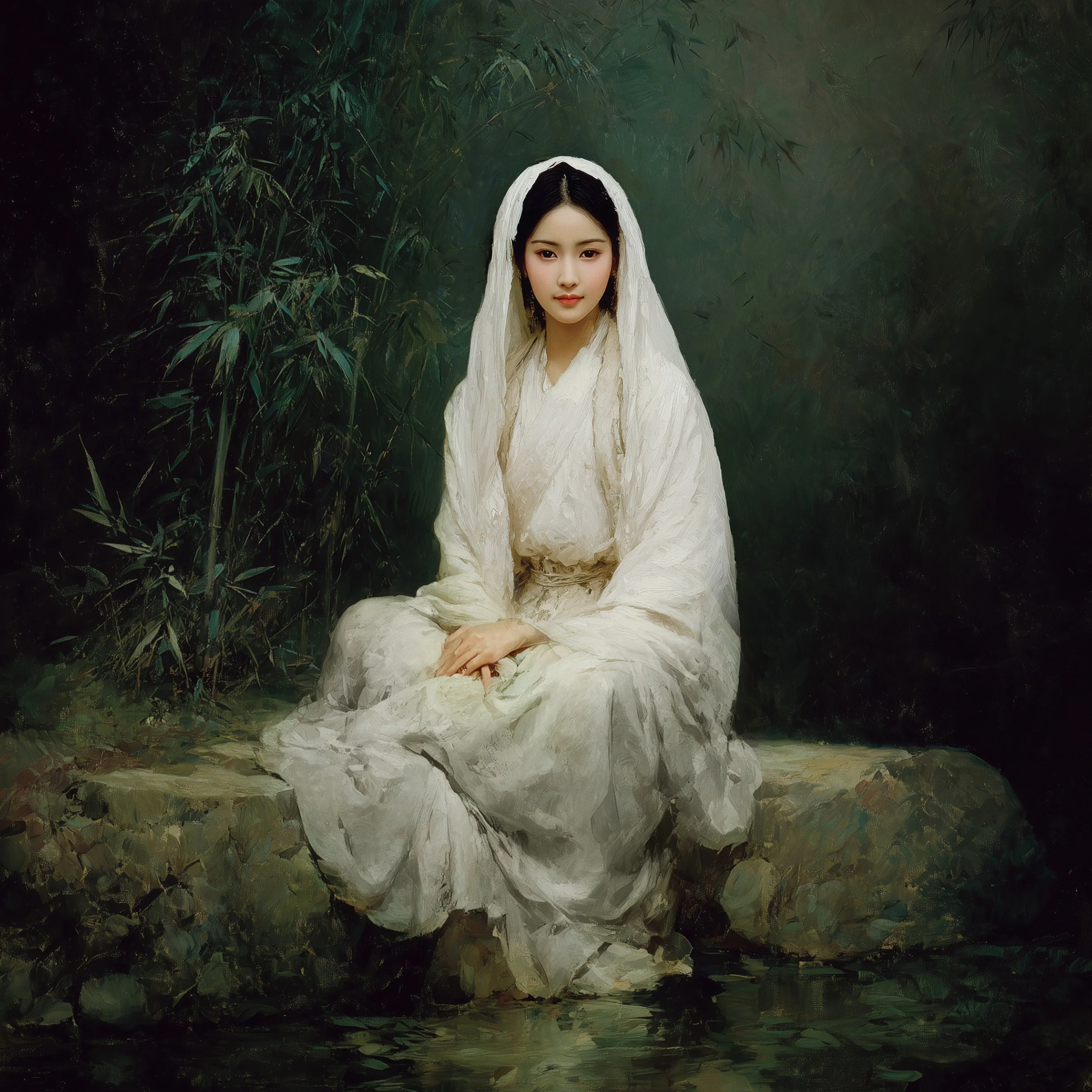
Guanyin, sometimes spelled Kuan Yin or Quan Yin in older texts, is one of the most beloved figures in Buddhism, and one of the most enduring symbols of compassion in human history. Her iconography is instantly recognizable: calm, steady, and quietly powerful, conveying mercy not as sentiment, but as presence. There is something in her expression and her strong yet fluid posture that settles the nervous system almost on contact. I keep a Guanyin statue in my garden, where she stands as a serene and compassionate overseer, a reminder of why she has been turned to for centuries in moments of fear, grief, and transition. There is something about her, even a statue, that feels protective, safe and comforting.
Guanyin is revered throughout Chinese Buddhism as a symbol of mercy, compassion, and unconditional love. She is a bodhisattva, a being who has reached enlightenment but chooses to remain in the cycle of rebirth to help others find liberation. Called the Goddess of Mercy, she embodies empathy in its purest form. She is deeply connected to water, which reflects her ability to flow with and understand the emotional currents of those who seek her aid.
Guanyin’s many names tell the story of how compassion travels and transforms. In the Lotus Sutra, Avalokiteshvara is described as a being who appears in whatever form is necessary to relieve suffering. Man or woman, divine or ordinary, familiar or unexpected. The teaching is clear: compassion is not fixed. It adapts. It meets people where they are. In India she was originally known as Avalokiteshvara, the bodhisattva of compassion, and was traditionally depicted as masculine or androgynous. When Avalokiteshvara’s worship traveled along the Silk Road and entered China, something beautiful happened. In Chinese culture, compassion was seen as a feminine quality, and gradually the bodhisattva’s art, stories, and rituals shifted. Avalokiteshvara softened into Guanyin, a goddess with flowing robes and a face that reflected the gentleness people already felt when they prayed to her. In Japan she became Kannon. In Tibet Avalokiteshvara is known as Chenrezig, and in Tibetan Buddhism the Dalai Lama is considered an incarnation of this same compassionate being. Across all these cultures, the form changes but the essence stays the same. Guanyin, Avalokiteshvara, Chenrezig, and Kannon are all faces of one great, compassionate presence. It is not about gender. It is about the shape compassion takes when the world calls for it.
For centuries, people have worked with Guanyin through direct invocation rather than elaborate ritual. Calling her name aloud, especially in moments of fear, grief, illness, or moral uncertainty, is one of the most widespread devotional practices associated with her. This act is understood not as pleading with a distant deity, but as attuning oneself to compassion itself, calming the mind and opening the heart to clarity and care.
One of the most well known Chinese stories about her is the legend of Miao Shan. In this tale, Miao Shan is a princess whose compassion is so profound that she renounces a life of privilege to pursue spiritual devotion. Her father, furious at her refusal to obey him, subjects her to trials and even attempts to kill her. Through her kindness, clarity, and refusal to return cruelty for cruelty, Miao Shan is eventually transformed into Guanyin. Whether this story is symbolic or based on older folklore, it speaks to the heart of her mythology. Compassion is not weakness. It is resilient. It is a choice made again and again, even under pressure. Another popular story is the tale of the fisherman who prayed to Guanyin while caught in a violent storm at sea. She appeared, calmed the waves, and guided him safely back to shore. This story highlights her as a protector, a guide, a divine presence willing to intervene when someone is overwhelmed or lost.
Some Buddhists believe that when a devoted soul leaves the world, Guanyin places them within the heart of a lotus and carries them to the western pure land of Sukhavati. In this tradition, she is not a judge or gatekeeper, but a compassionate guide who accompanies the dying through the transition from one state of being to another. Sukhavati is understood as a realm of clarity and awakening, free from the confusion and suffering that bind beings to the cycle of rebirth. To be carried there is not a reward for moral perfection, but an expression of grace and compassion, offered to those who turn toward her with sincerity. This belief situates Guanyin at the threshold between worlds. She stands with those who are afraid, disoriented, or in pain, offering reassurance and safe passage. In this way, her compassion extends beyond the struggles of daily life and into death itself, affirming that care does not end at the moment of leaving the body, but continues through rebirth and renewal.
Guanyin also appears in Taoist traditions, blended with local goddess lore, sometimes connected to the Jade Emperor’s daughter or other celestial beings. Her imagery is varied and richly symbolic. She is sometimes shown holding a vase of pure water or a willow branch, symbols of healing, renewal, and the softness that wears through stone. Sometimes she is shown with multiple arms or eyes, representing her ability to perceive suffering everywhere and respond in many ways at once, a form rooted in Indian Mahayana Buddhism, which shared symbolic language with early Hindu traditions. Traditionally, the many eyes represent the willingness to see suffering wherever it exists, while the many arms represent the capacity to respond. Together, they form a moral image: compassion that does not look away, and compassion that does not remain idle. These images remind us that compassion is not passive. It sees. It acts. It reaches into the world with purpose.
Guanyin is sometimes conflated with the Buddhist figure of Tara, particularly in modern art, but they are distinct bodhisattvas with different cultural lineages and roles. Guanyin, whose devotion developed primarily in East Asia, embodies a compassionate presence that listens, endures, and accompanies beings through suffering. Tara, central to Tibetan Buddhism, represents swift, decisive action that removes obstacles and responds quickly to danger. While both express compassion, Guanyin meets suffering by staying with it, whereas Tara meets it by cutting through it. In a symbolic sense, Guanyin and Tara function like complementary expressions of compassion, similar to how other traditions express different modes of a shared force. However, unlike pairs such as Kali and Durga or Sekhmet and Bastet, they are not understood within Buddhism as two forms of the same being.
Seen through a psychological lens, Guanyin functions as an archetype of responsive compassion, one that is actively cultivated rather than passively admired. Working with her traditionally involves direct invocation, remembrance, and imitation of her qualities, especially in moments of fear, grief, moral uncertainty, or emotional overwhelm. In this sense, Guanyin represents the capacity to witness suffering without becoming consumed by it, and to respond without hardening, withdrawing, or collapsing. She models an inner orientation in which attention is paired with action and care is paired with clarity. Rather than absorbing suffering, she meets it, offering a stabilizing presence at moments of threshold and transition. This makes her not only a figure of devotion, but a lived pattern of engagement, a way of relating to pain that preserves openness while maintaining discernment.
Her influence reaches far beyond Buddhism. People from many paths turn to Guanyin in times of trouble, grief, illness, or uncertainty. Temples dedicated to her are found across East Asia, filled with incense, prayers, and offerings of gratitude. In contemporary culture her presence is still powerful. She appears in art, literature, film, and in countless small altars in gardens, bedrooms, studios, and pool rooms, quietly shaping the modern imagination of what compassion looks like. For many contemporary practitioners, Guanyin is understood not only as a divine figure, but as a cultivated inner capacity: the ability to remain open without collapsing, to witness suffering without becoming hardened, and to respond without cruelty. This understanding does not replace her religious meaning. It extends it into lived experience.
Guanyin’s legacy is not just in myth, but in her message. She teaches that compassion is an active force, a choice we can make daily. Her stories remind us that softness is not the opposite of strength. It is another kind of strength entirely. Whether she is depicted as a celestial guardian, a peaceful goddess, or a divine mother figure, Guanyin endures as a beacon of healing, understanding, and hope in a world that often needs all three.