Aries Season, Ostara & Fire Energy
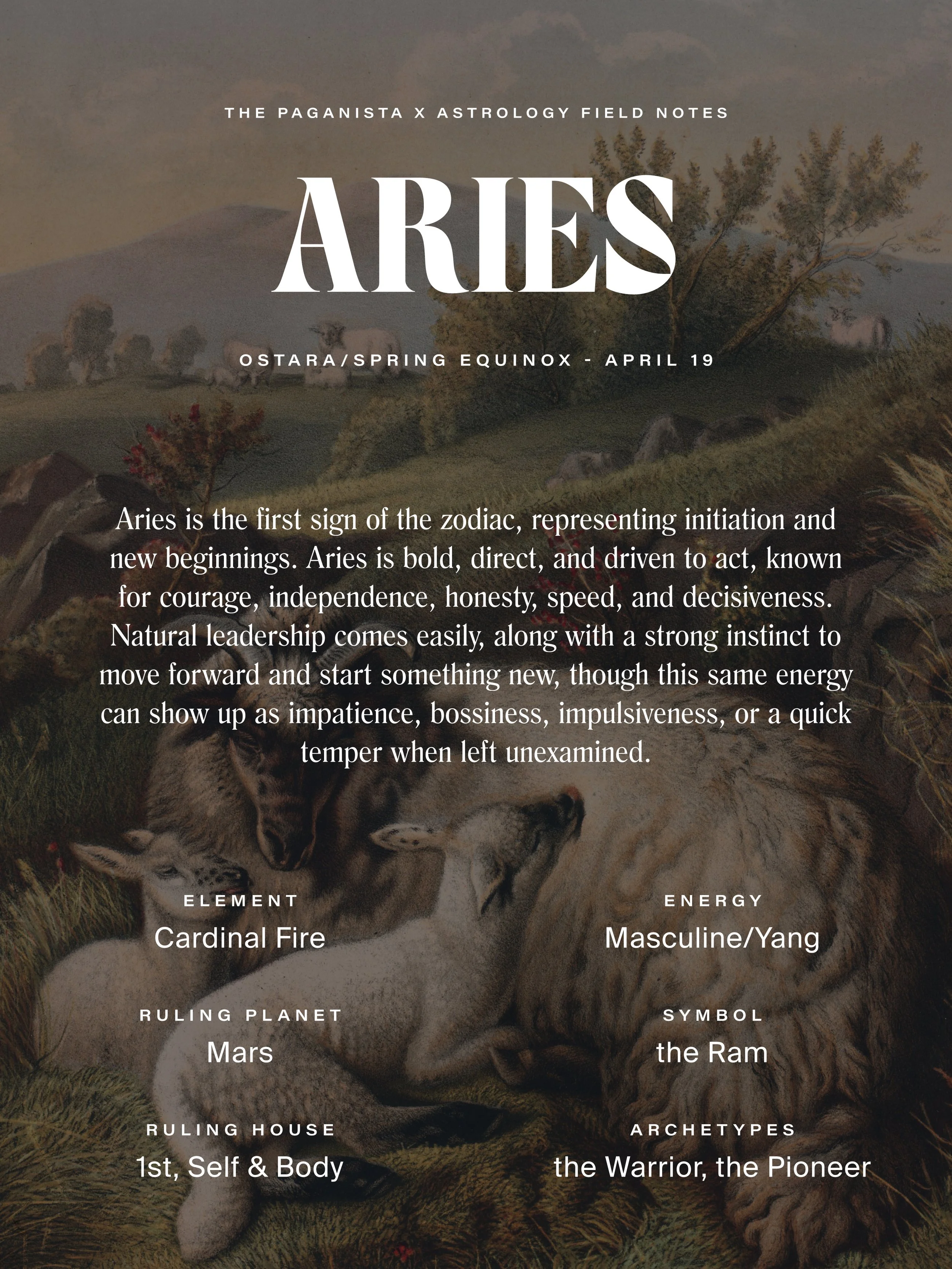
Aries season is here, and it begins the zodiac the same way Spring begins the year, with a surge of bold, expressive life after the quiet dormancy of Winter. Mercury in Retrograde also ends today, so if you’re feeling that extra push, like you’re stepping onto an accelerated airport moving walkway after standing still for a while, you’re probably not alone. Aries is the sign of initiation, bursting with potential and the desire to move life forward. Arriving just after the Spring Equinox, this cardinal fire sign carries the energy of initiation, the moment when potential turns into action. Cardinal signs mark the beginning of each season, and for those familiar with the Wheel of the Year, these turning points align with four of the eight sabbats. Aries marks the beginning of a new cycle, coinciding with the Spring Equinox and the celebration of Ostara, a festival of renewal, fertility, and the returning light.
If you’re interested in just the Aries energy, I’m doing a collaboration with Earth Altering. Check out her instagram for our 2026 Astrology collaborations!
Aries and Spring Energy
By the time Aries season begins, most of us can see and feel that changes in the world around us as well as within ourselves. That Aries spark acts as a catalyst for awakening, ready to push forward and start living again. Animals become active, searching for food and mates, seeds push through the soil, and we start to notice that pale electric green covering trees as the first sign of rebirth. After months of rest and stillness, something in us wants to move again with boldness and electric energy. This is the spark of life, the moment a fresh cycle begins, full of possibility. There are moments in the year that feel less like transitions and more like crossings, not gradual shifts, but distinct thresholds where something ends and something else unmistakably begins. Aries season arrives as one of those thresholds, where the change is not only visible in the world around us, but felt internally as a readiness to move.
Aries carries that same momentum. Ruled by Mars, Aries is associated with courage, instinct, leadership, and action. It is the sign of the pioneer, the one willing to take the first step when the path ahead is not entirely clear. Like the ram, Aries tends to meet life head-first, charging forward with confidence, instinct, and momentum. Rams are known for charging and head-butting when confronted with an obstacle, a behavior that mirrors the instinctive, confrontational energy often associated with Aries.
In its highest expression, Aries brings bravery, curiosity, initiative, independence, and decisive movement. In shadow, that same fire can become impatience, impulsiveness, aggression, or the tendency to charge forward without thinking things through. Aries can be stubborn and hot-headed at times, but it’s also bold, energizing, and quick to get things moving again. This isn;t a refined energy. It’s immediate, responsive, and alive, more concerned with beginning than with perfecting. In traditional astrology, Aries is also associated with the head and face, reinforcing the symbolism of the ram meeting life head-first, much like Aries itself leads the zodiac the way the head leads the body.
Ostara and the Turning of the Year
Ostara marks the Spring Equinox, the moment when day and night stand in perfect balance before the light begins to steadily overtake the darkness. Celebrated on or around March 20–21 in the Northern Hemisphere, Ostara represents renewal, fertility, and the awakening of life after the long quiet of Winter. Across many cultures this moment in the year was observed as the true beginning of the agricultural cycle, when the earth thawed, animals returned, and seeds could be planted once again.
The modern name “Ostara” is often connected to the Germanic goddess Eostre, mentioned by the 8th-century monk Bede, who wrote that a Spring festival honoring her once took place during this time of year. While historical evidence for the goddess herself is limited, the themes associated with the festival—fertility, dawn, rebirth, and the returning light—appear widely across Indo-European traditions. Symbols such as eggs, hares, and blooming flowers became associated with Spring for this reason, representing new life and the cyclical renewal of nature.
Astrologically, the Spring Equinox marks the beginning of Aries season. Aries is the first sign of the zodiac and the first of the cardinal signs, the group of signs that initiate the turning points of the year. The cardinal signs—Aries, Cancer, Libra, and Capricorn—correspond with the equinoxes and solstices, the four great seasonal gateways of the solar cycle. Aries begins Spring at the Spring Equinox, Cancer initiates Summer at the Summer Solstice, Libra opens Autumn at the Autumn Equinox, and Capricorn begins Winter at the Winter Solstice. This year, that threshold is especially pronounced, as the Sun’s entrance into Aries occurs on March 20, 2026, the same day Mercury stations direct, marking a simultaneous shift in both seasonal and mental momentum.
For those familiar with the Wheel of the Year in modern Pagan traditions, these four cardinal points align with four of the eight sabbats that mark the seasonal cycle. Ostara corresponds with the Spring Equinox and the beginning of Aries season, while the other cardinal signs align with Litha, Mabon, and Yule. The remaining four sabbats—Imbolc, Beltane, Lughnasadh, and Samhain—fall at the midpoints between these seasonal gateways and correspond more closely with the fixed signs of the zodiac. This alignment between astrology and seasonal festivals reflects an ancient awareness of cyclical time. Long before astrology was formalized as a symbolic system, human cultures were already observing the rhythms of the Sun and the seasons. The equinoxes and solstices marked natural turning points in the year, and the zodiac later mirrored this structure in symbolic form.
Because of this connection, Aries and Ostara share a deeper meaning. Both represent the same moment in the cycle of the year: the return of movement, vitality, and new beginnings. Just as Ostara celebrates the reawakening of the earth, Aries embodies the spark of life that pushes forward after a period of dormancy. It is the moment when potential becomes action and a new cycle begins. With Mercury stationing direct at the same time, what has been internal or unresolved begins to move outward again, not because everything is clear, but because the readiness to act has returned. This is fiery energy is further amplified by the concentration of planets currently in Aries, including Venus, Saturn, Neptune, and Chiron, creating a beginning that is not simple or singular, but layered with desire, responsibility, vision, and healing all at once.
The Psychology of Beginnings
Psychologically, Aries reflects the beginning of the individual self. It is the stage when we start discovering who we are and how we move through the world, shifting from watching life happen to actively participating in it. Carl Jung often wrote about the development of the ego as a natural and necessary part of growing up, the process through which a person begins to understand their identity as an individual.
Aries carries that same archetypal energy. As the first sign of the zodiac, it represents the earliest stage of the human journey, the raw, youthful life force that begins everything. It is the Warrior, the Pioneer, the Trailblazer, and sometimes the Rebel. In their light expressions, these archetypes embody courage, protection, leadership, and the willingness to forge new paths. In their shadow forms, they can become the reckless fighter, the impulsive risk-taker, or the leader who moves too quickly and forgets to listen. Aries learns through action. It is the part of the psyche that moves first and understands later.
The Myth of the Golden Ram
The symbol of Aries is the Ram, specifically the golden ram Chrysomallos, connected to the myth of the Golden Fleece in the Greek epic Jason and the Argonauts. But like many astrological symbols, the story goes back even further than the Greeks. In ancient Mesopotamian astronomy, this region of the sky was associated with the beginning of the agricultural year, when the land thawed and the planting cycle began again. Babylonian star texts refer to this constellation as the “Agrarian Worker” or “Hired Man,” another symbol tied to seasonal renewal and the start of the farming cycle.
In the Greek myth of Phrixus and Helle, the ram appears as the unlikely hero of the story. Their father, King Athamas, had abandoned their mother, the cloud nymph Nephele, and remarried a woman named Ino, who had little interest in raising another woman’s heirs, especially ones who might threaten her own children’s claim to power. And so Ino started scheming, secretly sabotaging the crops, which led to a devastating famine. Ino then convinced the people that the gods demanded a sacrifice to end the famine and heal the land, conveniently suggesting her stepchildren, Phrixus and Helle. It is yet another example of the conniving, jealous wicked stepmother trope that echoes across myth, folklore, and fairy tales throughout history.
Just as the sacrifice was about to happen, their mother, the cloud nymph Nephele, intervened. Unable to protect them directly, she sent a miraculous golden ram, Chrysomallos, to rescue them. The ram lifted the children onto its back and carried them away through the sky. Helle lost her grip during the journey and fell into the sea below, which is why that stretch of water is still called the Hellespont. Phrixus, however, made it safely to the distant land of Colchis.
To thank the gods for saving him, Phrixus sacrificed the ram to Zeus and hung its golden fleece in a sacred grove guarded by a dragon. Personally, I think Phrixus did that ram a little dirty. If a magical flying sheep saved my life, I would probably be looking for a better thank-you gift than slaughtering my rescuer, but that is just me. And we have to remember that ancient myths tend to be very strange, unpredictable, and violent, reflecting the world in which they lived. And so Zeus placed the golden ram Chrysomallos among the stars for his daring feats and sacrifice, where it still shines today as the constellation Aries. The Golden Fleece itself became a powerful symbol of divine favor, kingship, and destiny, the prize later sought by Jason and the Argonauts in one of the most popular and enduring epics from Ancient Greece.
Across cultures, the symbolism is surprisingly consistent. Aries represents the spark that begins a new cycle, the moment life pushes forward again.
Warrior Archetypes and Sacred Fire
For those who work with mythic archetypes or deities, Aries energy is associated with fire, courage, war, and protection. In the classical world, this includes the Greek god Ares and his Roman counterpart Mars, the planet that rules Aries. Athena represents a more strategic, intelligent, and feminine expression of this warrior archetype. Across other mythologies, similar warrior energies appear in many forms. Sekhmet, the fierce Egyptian lioness goddess of destruction and purification, embodies the blazing force that burns away corruption so renewal can begin. In the Norse tradition, Tyr represents courage, sacrifice, and martial honor, while Thor embodies strength, protection, and the thunderous force that confronts chaos directly. In Yoruba tradition, Ogun, the god of iron and war, represents the raw power to clear obstacles and forge new paths.
Some of these figures are also strongly associated with other archetypal energies in the zodiac. Sekhmet, for example, is often linked symbolically with Leo through her solar and leonine imagery, while the Celtic war goddess Morrígan, who presides over battle, fate, and transformation, often resonates more closely with Scorpio. For me, I feel especially called toward Athena, Sekhmet and Freyja, but it varies like the seasons. Like the archetypes themselves, these mythic figures rarely belong to only one symbolic domain.
Together they reflect a deeper lesson of Aries: courage isn’t just about conflict. It’s about the willingness to act, protect what matters, and begin.
The Lesson of Aries
Aries reminds us that every cycle starts the same way, with a spark of fire, a moment of instinct, and the courage to move. It is the energy of beginnings, the force that pushes life out of dormancy and into motion. Just as the first shoots of Spring break through frozen ground, Aries represents the will to act even when the outcome is uncertain.
At its heart, Aries is the archetype of the initiator. It is the part of us that is willing to go first, to try something new, to lead when no clear path exists yet. This is why Aries is associated with courage and leadership, but also with impatience and risk. The same fire that fuels bold action can just as easily become recklessness if it burns too hot.
Spiritually and psychologically, Aries represents the birth of identity and of the self. If Pisces is the dream, then Aries is the awakening. It is curiosity, instinct, and the willingness to step into the unknown. Every journey, every idea, every transformation begins the same way, with the courage and conviction to take the first step into the unknown.